
The most important hire probably isn’t your VP, it's your Directors.
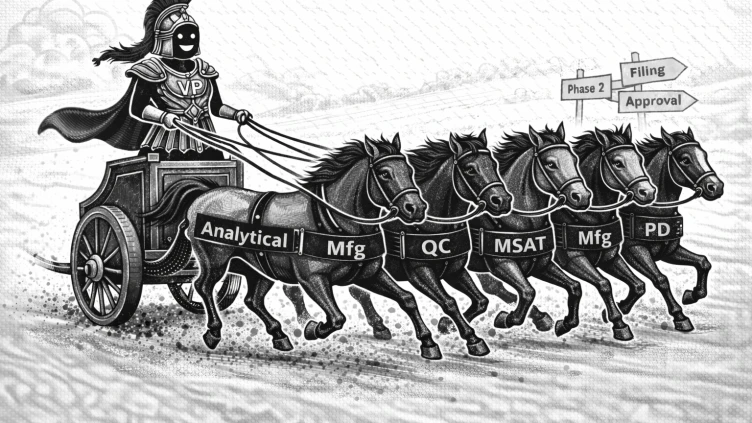
“I just need someone who can take this off my plate.”
That’s how most Director searches start.
Not with strategic workforce modeling. Not with succession planning.
With a VP who is drowning.
And here’s the pattern across Series A through pre-IPO biotech:
The hire framed as support often becomes the structural determinant of whether the company scales.
The Org Chart Looks Logical. Scaling Isn’t.
In CMC, the hierarchy is predictable:
CTO → VP, CMC / Tech Ops → Directors (Process Development, Analytical, MSAT, Manufacturing, QC, Formulation, Supply Chain)
The CTO works with the CxO team and the Board to choose the destination. The VP aligns priorities, sequencing, and capital.
The Director layer decides what actually happens.
This is where strategy meets friction.
If friction wins, the company slows — regardless of how strong the strategy looked in the board deck.
Directors Don’t “Support.” They Convert Complexity into Thrust.
Biotech rarely lacks intelligence.
It lacks controlled propulsion.
Energy is abundant. Ideas are sophisticated. The science is often exceptional.
What’s missing is thrust.
Directors are the conversion engine.
They take regulatory ambiguity, unstable methods, CDMO drift, capital constraints, and cross-functional tension — and turn it into forward force.
They convert:
“We believe this process will scale”
into
“Here is the data package, the comparability plan, the tech transfer timeline, the vendor accountability structure, and the real risk profile.”
Without them, strategy remains potential.
With them, complexity becomes thrust.
And in a Series B or C company staring at a Phase 2 readout and 18 months of runway, thrust — not enthusiasm — is what extends survival.
VPs Get the Credit. Directors Carry the Load.
This is the uncomfortable truth.
Your VP can be exceptional.
If your Director bench is average, the company will average.
A strong Director:
– Pushes back on optimistic CDMO timelines before they infect the operating plan – Kills a failing assay early instead of protecting sunk cost – Pulls Regulatory and Quality into the room before the problem is institutionalized – Designs stability programs around filing strategy, not scientific elegance
They do not manage tasks.
They manage consequence.
When CMC slips relative to clinical, it is rarely because the VP lacked vision.
It is because execution at the Director level could not absorb complexity at speed.
Director → Snr Director → Executive Director: Title Doesn’t Change the Mandate. Consequence Changes the Margin.
This progression isn’t philosophical.
It’s gravitational.
At Director, you own a domain and are accountable for its output.
At Snr Director, you own interconnected domains. You are expected to detect friction before it becomes escalation.
At Executive Director, you operate at portfolio scale. A missed handoff doesn’t frustrate a team — it affects financing narratives and Board confidence.
The mandate does not change:
Translate priorities into execution.
What changes is the weight of consequence.
The best across all three levels understand the real chain:
Method → Data → Filing → Credibility → Capital → Control.
Because once credibility slips, capital gets expensive.
And when capital gets expensive, control shifts.
If someone advances in title without expanding in systems awareness, they are not scaling.
They are accumulating scope.
Why Phase 3 Search Loves This Level
Don't get me wrong, I love a great CEO/CTO/SVP search.
BUT the Director layer is where ambition collides with physics.
It’s close enough to the work to feel friction in real time. Senior enough to influence outcomes beyond a single function. Exposed enough to consequence to understand what actually matters.
This is where future VPs are formed.
Not in executive offsites but in tech transfers that almost fail. In comparability exercises that surface uncomfortable truths. In cross-functional battles where someone has to choose alignment over ego.
We love this level because it’s honest.
There’s nowhere to hide behind vision. No room for ornamental leadership.
Either you convert complexity into thrust — or the company slows.
And if you want to know who will carry your organization through Phase 3 and beyond, watch the Directors who step into consequence early.
That’s usually where the real leaders are forming.
The Hire You’re Probably Underestimating
If you want to understand whether your biotech will scale through Phase 3 and beyond, don’t start with executive biographies.
Start with your Director bench.
They control velocity. They absorb complexity and convert it into thrust. They operate inside the Method → Data → Filing → Credibility → Capital → Control chain — whether they realize it or not.
Scientific brilliance creates potential.
Director-level leadership determines whether that potential converts into enterprise value.
And in biotech, conversion — not ambition — is what determines who survives.
If this is your discipline, let's talk.
Every engagement begins with a diagnostic — a structured read on the role and the company you are actually inheriting.
Start a diagnostic Our CTO & technical leadership practice →