
When to Hire What in CMC, and How to Defend It to a Board Counting Every Dollar
TL;DR
The technical hires a board asks you to defer are usually the ones protecting the valuation they are raising on. Read on for what each CMC hire buys, when it earns its seat, and how to make that case to a board that measures everything in milestones and months of cash.
“Can this one wait until after the raise?”
You have heard that question in a board meeting, and you have probably said it yourself. It tends to arrive the moment someone proposes a technical hire that does not line up neatly against a clinical milestone, something like a process development lead, a head of analytical sciences, or a quality leader who wants to stand up a data integrity system before anyone outside the building is asking for one. The science is moving, cash is finite, and the next round is priced on the milestones already on the slide. So the hire gets parked under some version of the same language: next round, once we have more visibility, when we actually need it.
That instinct is not careless. It is how disciplined boards protect runway, and most of the time conserving capital is the right reflex.
It is also how companies quietly accumulate the one category of risk that gets repriced by someone with far less patience than their own board: the FDA, an acquirer’s diligence team, or the next investor.
Why the Deferral Feels Rational
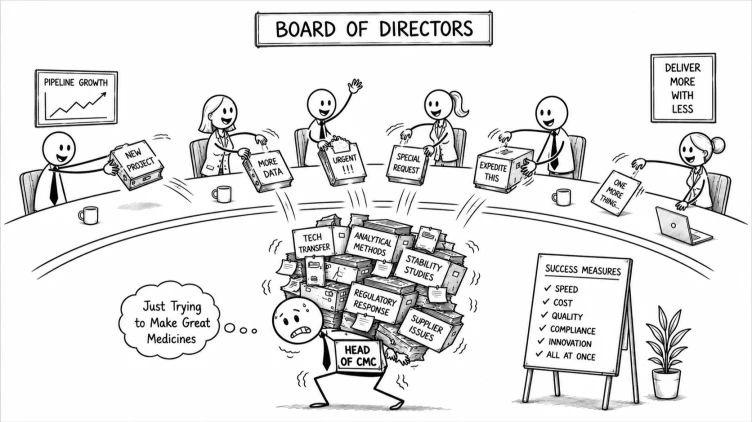
Boards know how to price clinical risk. They have models, base rates, and decades of governance practice built around endpoints, trial design, and readouts. They are far less practiced at pricing operational risk, because process development does not photograph well. “We finished characterizing the critical process parameters” never moves a number the way “we dosed first patient” does. When capital is tight, the spend that survives is the spend the next investor can already see.
Here is the mechanism that makes the deferral feel free. When a process is under-resourced early, the failure does not show up as a missing hire. It surfaces eighteen months later as a deviation backlog, a failed tech transfer, or a Complete Response Letter, and by the time it lands it gets logged as a quality problem rather than as a staffing decision made back when the organization was small and the runway was tight. The cost lands. The attribution is gone.
None of that appears on a burn chart, which is precisely what makes it dangerous to manage by one.
What a CMC Hire Actually Buys
It helps to be specific about what you are purchasing, because “a Head of CMC (VP/CTO)” is three different things wearing one title.
The first is leadership. Not seniority, but the capacity to see one stage ahead, to know what the function will need before the need is urgent, and to translate technical risk into language a board and an investor can act on. A technical leader who cannot explain a process risk to a non-technical director has work to do but does not yet have a strategy. It's also worth noting that as a company travels further down the path that this hire needs to see further and further ahead in order to mitigate a fractal of optionality and risk.
Underneath leadership is subject-matter depth. The actual disciplines: process development, process characterization, analytical method development, bioassay and potency work, and whatever the modality specifically demands. This is the layer that determines whether a problem ever gets flagged at all. Your leader needs to be able to dig for the unseen risk, call BS when they see it, and drive a gold standard without being a dictator. Without real depth in the room, the issues that later become CRLs are simply never seen early enough to be cheap to fix.
And underneath both is capacity. Heads and hands enough to do the work to the timeline you have committed to. Your leader has to be able to know what is non-negotiable and what can be supplemented fractionally in the short term. Capacity is the first thing cut when cash is tight and the last thing anyone names in a board update. A team running at 130% utilization has not given you a process; it has given you a plan held together by heroics, and one that you need a your CMC leader to replace.
Each of those layers fails in a predictable way when it is missing. A company that has leadership but no depth ends up with a confident narrative and no one positioned to surface the problem underneath it. Depth without the leadership to deploy it produces engineers who have no authority to stop the train. And a company that has both but is starved for capacity produces the most expensive failure of the three: people good enough to keep a failing system upright until they burn out and it something finally buckles.
The Work You Cannot Outsource
“We can outsource it” is the natural response when boards push back on a CMC hire, and up to a point that response is right. A huge number of early-stage biotechs outsource activity: 85% of small biopharma companies contract out API manufacturing and 77% outsource finished dose. The work itself gets contracted out, the cash discipline is real, and the CDMO model is what makes development-stage biotech possible at the scale it operates today.
What gets missed is that outsourcing transfers activity, not accountability. However, the FDA holds the sponsor responsible for what happens at the contract site. The IND, the BLA, the comparability case, the data integrity audit, and the pre-approval inspection all land at the sponsor’s address regardless of whose floor the work happened on. Statistically, contract sites account for roughly half of facility-deficiency CRLs for biologics, and not one of those letters was addressed to the CDMO.
What cannot be outsourced is the judgment to read what the CDMO is delivering. Someone inside the company has to know whether the process characterization data is sufficient or only complete, when to push back on a comparability protocol that looks clean on paper but will not hold up to an FDA challenge, and how to translate a deviation trend at a contract site into a runway impact the CEO and CFO can act on before the trend becomes a finding. That work cannot be done part time. That part is not a fractional engagement. It is internal judgment, sitting at the table when decisions get made, with the authority to say no and push for a higher standard.
Which is often what the hires that the board is trying to defer actually do.
When Each Hire Earns Its Seat
“Wait until we need it” is the wrong test because the dominant risk moves underneath the company. The hire that is premature at one stage is overdue at the next, and the gap between those two moments is where the cost hides. The CTO Mandate Framework lays out the full stage-by-stage map; the short version is enough to plan against.
Early, before the IND, the dominant question is whether the molecule can become a product at all, the Possible mandate. You do not need a commercial-scale manufacturing executive here. You need translation: someone in the room when the target product profile and the molecule itself are being set, so the company does not lock in a formulation or a modality it cannot reliably make later. The hire at this stage is doing judgment work. The infrastructure hires come later BUT they cannot undo what the judgment hire missed.
Through Phase I and II, reproducibility becomes the dominant risk. This is the quietest window and the most frequently deferred, which is exactly why it is the highest-leverage one. This is where subject-matter depth earns its keep, the people who turn “it worked in the last batch” into “it will meet specification in every batch, in a facility we do not own.” Under-hire here and the bill arrives at filing, with interest.
Approaching a filing or a major raise, the dominant risk shifts again, to whether the company survives outside scrutiny, the Acquirable / Investable mandate. Now the hire is quality and data integrity leadership: the documentation discipline and answer stability that hold up when a diligence team or a pre-approval inspection arrives. That readiness has to extend across your CDMOs as well as your own walls, because the sponsor name on the filing is the only name that matters when the inspection happens.
Past that, as programs multiply, you are hiring for scale, the enterprise architecture that lets a platform carry several programs without a local fix breaking the whole. And at commercial, you are hiring for durability: second sources, inventory for critical inputs, and the inspection readiness that keeps a launch from being held hostage by a single filler.
How to Make the Case to a Board Counting Runway
Arguing the hire on its cost is the losing ground. A salary line is easy to defer and easy to lose an argument about. The conversation gets traction on the asymmetry instead, and the asymmetry is stark.
The cost of the hire is a known, bounded number on the budget. The cost of the deferred hire is a manufacturing CRL that has taken a third of comparable companies’ value in a day and added 1.28 years to approval, or an acquirer who prices the unresolved gap into a contingent value right and shifts the risk back onto your shareholders. One of those numbers is a line item. The other is a repricing event measured in hundreds of millions. A board that conserves capital by deferring the first is often spending far more capital on the second, just later, and to someone else’s benefit.
So change the question you put in front of the board. Not “can we afford this hire,” but “what does not making it cost us at the next financing, if a diligence team finds the gap before we close it?” Two questions tend to be enough to get the conversation moving in the right direction. Which of our current CMC decisions could we defend on paper alone, without the person who made them in the room? And where in the operation are we assuming heroics, and what is the plan the day the person carrying those heroics leaves?
A timing dividend is worth naming as well. A credible technical leader in the room before the raise, rather than after, changes the diligence story you can tell and the terms you are able to hold. The right CMC hire does not only protect the valuation. At the right moment, it improves it.
The Framework Behind This
The sequencing above sits inside the CTO Mandate Framework we published this month: the five mandates a technical operations leader carries, and how their relative weight shifts as a company moves toward each capital event. The framework’s value is proportionality. Matching the depth of technical hiring to the dominant risk at each stage, so a board never overbuilds early or under builds right before the moment of maximum scrutiny.
If you are mapping your own technical org against your next raise, that is the conversation Phase 3 Search exists to have. Sometimes that means placing the leader the stage now demands. Other times it means helping a board see which hire is the constraint, and when it earns its seat.
Closing this out....
Every funding milestone is a promise about the future. The technical hires you make against it are how you keep that promise once someone finally tests it.
The CMC deferral that protects this quarter's burn can become the reason next year's approval slips. And in this industry, a slipped approval is not only a number on a chart. When an asset clears the science and stalls on operations, the loss shows up in the share price, and it shows up in the people who were waiting for the therapy to arrive.
Yes, runway is worth protecting. So is the boat all of you are traveling in. R&D and clinical are the engine; CMC is the hull. And while the engine determines how fast you go, the hull determines whether you make it at all.
If this is your discipline, let's talk.
Every engagement begins with a diagnostic — a structured read on the role and the company you are actually inheriting.
Start a diagnostic Our CTO & technical leadership practice →