
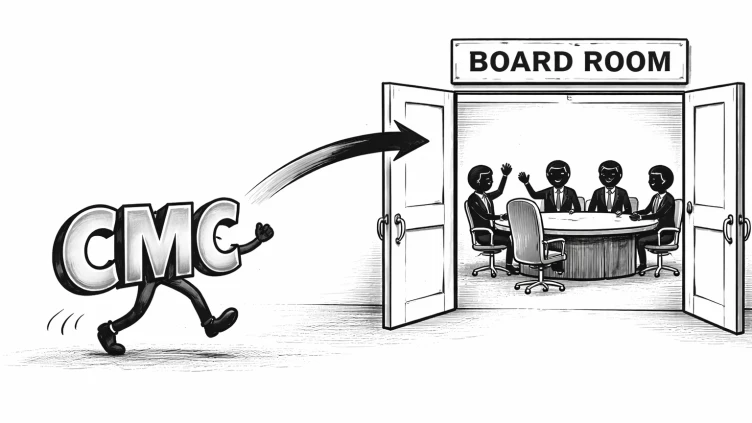
Why it's time for a CMC Voice in the Boardroom...
TL;DR:
Boards with CMC or technical operations expertise make better capital decisions, detect risk earlier, and govern CDMOs more effectively. With funding tighter than ever and no margin to re-run what should have been governed correctly the first time, the question is not whether you can afford CMC expertise in the boardroom — it is how you can afford not to.
Read on for a an depth breakdown of why:
There is a moment in most biotech boardrooms when someone says, "Manufacturing is on track, correct?"
Heads nod. The slide advances. The real risk stays buried in an appendix no one knows how to interrogate.
That moment doesn't usually happen at IPO.
It happens earlier — often around Series B or C — when the clinical program is accelerating, CDMO relationships are multiplying, and capital decisions start resting on technical assumptions no one in the room is fully equipped to pressure-test.
Boards are built to understand the risks they've lived through: capital structure, clinical probability, regulatory strategy, commercial positioning.
CMC and technical operations often sit just outside that frame.
Not because they are unimportant. Because no one in the room has the instinct to ask the next question.
And in biotech, what the board can't see, it can't govern.
Why CMC Expertise Changes the Room
Adding a CMC-experienced voice to the board is not about supervision.
It's about pattern recognition.
Most CMC updates sound reassuring:
"Process development is progressing."
"Tech transfer is underway."
"The CDMO is performing well."
A board member who has actually scaled a process hears something different.
They ask:
On track relative to what baseline?
What does the comparability strategy assume if we change sites?
How robust are the analytical methods beyond this phase?
Are the bioassays validated for potency, or are we relying on interim methods that won't hold at filing?
What capacity commitments does the CDMO have outside our program?
If timelines compress, what breaks first?
These are not adversarial questions.
They are early-warning systems.
Most CMC failures don't arrive as events. They accumulate as conditions.
A method that works, but hasn't been stress-tested for robustness. A CDMO relationship that's functional, but strained. A validation strategy that will hold for Phase 2, but not for a pre-approval inspection.
Without CMC fluency in the room, these conditions look like "on track."
With it, they look like enterprise risk.
The Inflection Point: When It Starts to Matter
In Series A, the science is the risk.
Board oversight of manufacturing is appropriately light. The process is still forming, the CDMO relationship is simple, and capital is allocated to generate proof-of-concept data.
By Series B, that changes.
Now the board is making decisions about:
Headcount in tech ops
Long-term CDMO commitments
Process characterization investments
Facility strategy
Analytical infrastructure
These are capital allocation decisions.
But they depend on technical assumptions.
If no one on the board can pressure-test those assumptions, the company builds a clinical timeline on a manufacturing foundation that may not hold.
By Series C and into Phase 3, tolerance for ambiguity collapses.
Comparability packages. Inspection readiness. Supply chain continuity. Process robustness.
These are no longer operational details.
They are valuation drivers.
Companies that added CMC fluency at Series B make different decisions here.
Companies that didn't make the same decisions — just with less information.
The Risks a CMC-Savvy Board Helps Avoid
1. Misallocated Capital
When CMC risk is invisible, infrastructure gets underfunded.
Boards understand clinical risk, so clinical milestones get resourced. Manufacturing robustness often gets deferred.
A CMC-experienced board member can articulate, in financial terms, why a $3M investment in process characterization now may prevent a $15M remediation later.
That's not technical nitpicking.
That's capital efficiency.
And boards are built to respond to capital efficiency arguments.
2. Late Detection of Technical Fragility
Most manufacturing setbacks that derail timelines didn't begin as crises.
They began as "manageable" technical compromises.
A board with CMC instinct sees fragility earlier:
Where process variability hasn't been fully mapped
Where scale-up assumptions are optimistic
Where analytical methods are phase-appropriate but not lifecycle-ready
Where regulatory inspection risk is accumulating quietly
The earlier a board names the condition, the cheaper the correction.
Silence compounds.
3. Weak CDMO Governance
CDMO relationships are among the most consequential partnerships in biotech — and often the least governed at the board level.
Boards typically receive filtered updates. That works when the relationship is healthy.
When it drifts: capacity reallocation, quality signals, subtle priority shifts and the board may not realize the exposure until operating plans have already absorbed the impact.
A CMC-experienced board member knows what healthy CDMO performance actually looks like. They recognize leading indicators. They understand when friction is normal, and when it's structural.
That distinction can preserve both timeline and leverage.
4. Suboptimal Senior Technical Hires
Boards influence CTO, SVP CMC, and QA leadership decisions.
Without functional depth in the room, hiring often defaults to résumé pattern-matching.
A CMC-literate board member can evaluate something more nuanced: Does this leader's operating instinct match the specific inflection the company faces?
There is a difference between a strong CMC executive and the right CMC executive for a transition from Phase 2 to commercial readiness.
Twelve months can disappear in that distinction.
This Is Not About Adding a Seat. It Is About Adding a Lens.
The CMC voice does not have to be a full voting director.
It can be:
A Board Observer
A technical advisory committee member
A strategic advisor embedded in quarterly reviews
The structure matters less than the access.
What matters is that someone with deep technical operations fluency has:
Visibility into board-level assumptions
Standing to ask reframing questions
Credibility to translate technical nuance into enterprise risk
The cost of adding this lens is modest.
The cost of its absence compounds.
The Structural Advantage
Biotech companies rarely fail because they didn't know the science.
They fail because risk accumulated in places leadership did not fully see.
Boards that include CMC or technical operations expertise:
Make better capital decisions
Detect risk earlier
Govern CDMOs more effectively
Align technical infrastructure with financing strategy
Preserve optionality under pressure
The value is not operational supervision.
It is informed governance.
In biotech, the distance between a board decision and manufacturing reality can stretch quickly.
A CMC voice shortens that distance.
And shortening that distance — before pressure hits — is often the difference between momentum and remediation.
With funding tighter than it has been in years, the margin for error has compressed. There is no second chance to re-run a failed tech transfer. No do-over on a comparability package that doesn't hold. No extra round of capital to fix what should have been governed correctly the first time.
The question is not whether you can afford to add CMC expertise to the boardroom.
The question is how you can afford not to.
Where Phase 3 Search Comes In
We help biotech companies build leadership teams and advisory structures across the CMC, QA, and technical operations landscape.
Sometimes that means placing the CTO or SVP who can build the translation layer between technical operations and the board. Other times it means helping companies identify experienced CMC operators who can serve in advisory or board-adjacent roles — people who have navigated the Series B-to-commercial arc before and know what good governance looks like from the inside.
The companies that do this well don't just build better boards.
They build boards that can see further.
And in biotech, the ability to see around corners is not a luxury.
It is a structural advantage that compounds with every decision the board makes.
If this is your discipline, let's talk.
Every engagement begins with a diagnostic — a structured read on the role and the company you are actually inheriting.
Start a diagnostic Our CTO & technical leadership practice →