
The CEO’s Capital Problem: Every Dollar Comes With Strings Attached
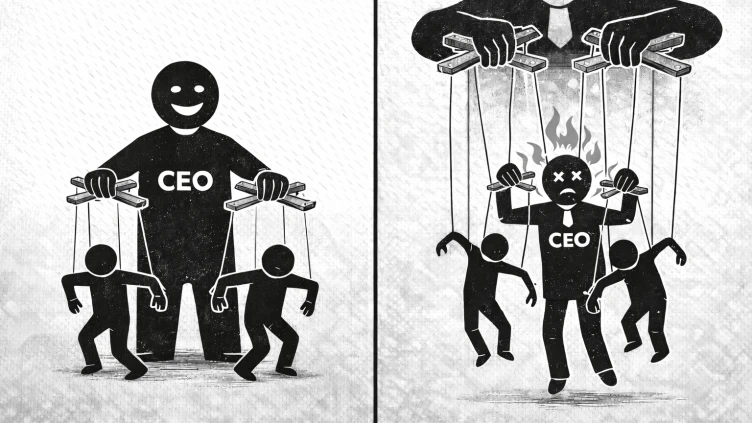
TL;DR Capital doesn’t just fund growth. It rewires trust, authority, and decision-making. When CEOs respond by absorbing more decisions instead of building trust through accountability, they become the bottleneck — and eventually the marionette. The way out isn’t control. It’s trust. And trust is built differently with your team than with your board.
Raising capital feels like progress.
A successful round buys time, ambition, and relief. It creates the sense that the hardest part is behind you.
It isn’t.
Every dollar that enters the company arrives with expectations — some explicit, many unspoken. Headcount accelerates. Reporting tightens. The board’s questions change shape. The company starts running on promises as much as data.
And slowly, the CEO’s job changes.
How Capital Quietly Changes the System
Early capital is forgiving.
Investors tolerate ambiguity. Decisions are reversible. Speed matters more than polish. Trust is implicit.
Later capital is different.
The cost of mistakes rises. Optionality narrows. Governance hardens. Decisions that once lived in hallways move into decks, committees, and pre-reads.
A few diagnostic signals show up consistently:
Decision velocity slows even as resources increase
The CEO becomes the default risk absorber again
Leaders optimize for defensibility instead of outcomes
Operating questions turn into narrative exercises instead of measurable progress
None of this feels like failure.
It feels like maturity.
That’s what makes it dangerous.
The Tradeoff No One Names — and the Terrible Lesson It Teaches
Here’s the tension capital introduces and few CEOs say out loud:
More money increases accountability — but redistributes authority.
The CEO still owns outcomes. But fewer decisions are truly theirs to make alone.
When authority is unclear, trust erodes. When trust erodes, leaders hesitate. When leaders hesitate, escalation replaces ownership.
So the CEO steps in.
At first, this feels responsible.
But without realizing it, the organization is taught a terrible lesson:
If you wait long enough, the CEO will decide. If something feels risky, escalate instead of owning it.
That lesson compounds fast.
The CEO becomes the connective tissue. Then the bottleneck. Then something worse.
Still accountable, but increasingly constrained. Still visible, but pulled by strings they never agreed to.
This is how CEOs become marionettes.
The Burnout Nobody Wants to Name
Marionette CEOs burn out.
Not suddenly. Gradually.
Decision quality degrades. Risk tolerance distorts. Communication shortens. Patience thins.
This isn’t a personal failure. It’s a trust failure.
When a CEO can’t trust the system, the system leans on the CEO until something breaks.
What Actually Cuts the Strings
The thing that cuts all strings is trust.
But trust isn’t abstract.
Trust with your team comes from accountability and metrics. Clear ownership. Clear expectations. Measurable outcomes.
When people know exactly what they own — and how success is judged — they stop escalating and start deciding.
Trust with your board comes from results. Not promises. Not narratives. Not activity.
Outcomes earn autonomy.
When the team delivers against clear metrics, results accumulate. When results accumulate, board trust follows. And when board trust follows, the CEO regains real agency.
Accountability and metrics are not bureaucracy. They are the foundation of trust.
Where Phase 3 Search Fits
This is often where Phase 3 Search is brought in — not because the CEO lacks judgment, but because the trust architecture hasn’t kept pace with the capital.
We see which structures allow trust to scale — and which ones quietly force CEOs into heroics.
Sometimes the answer is bringing in leaders who have owned clear outcomes under scrutiny before. Other times it’s clarifying decision rights, accountability, and metrics so trust can actually form.
We do both.
Because without trust, capital turns CEOs into marionettes. With trust, capital becomes leverage.
The Closing Reality
Great CEOs don’t try to pull fewer strings.
They cut them.
They build trust with their teams through accountability and metrics.
They earn trust with their boards through results.
They don’t absorb ambiguity forever.
They don’t confuse endurance with leadership.
They don’t let governance quietly train the organization to escalate instead of decide.
They design trust before it’s tested.
Because a CEO who can trust can scale. And a CEO who can’t eventually breaks — or breaks what they’re trying to build.
If this is your discipline, let's talk.
Every engagement begins with a diagnostic — a structured read on the role and the company you are actually inheriting.
Start a diagnostic Our CTO & technical leadership practice →