CMC -> The Default Model Is Not the Only Model
The Default Model Is Not the Only Model
TL;DR: The traditional biotech operating model — discovery hands to development, development hands to manufacturing, everyone stays in their lane — is not wrong. It is just not the only option. It was designed for a world where capital was abundant and time was forgiving, and that world is gone. A smaller number of companies are experimenting with something different: fewer handovers, more shared context, clinical pharmacology and CMC in the room at candidate selection, quality functions that know when to hold the line and when to adapt around it, and leaders who identify with the asset rather than their function. This article is the case for considering that alternative. Not a verdict on the default. An invitation to ask whether the model you are running is the one you would choose if you were starting from scratch today.
You hear it in different forms, but it is the same sentence.
"We just need to move faster."
Sometimes it comes from the CEO after a board meeting. Sometimes from the board itself, usually tied to runway. Occasionally from the CSO, when the data is promising but the timeline is not.
The reflex response is to push harder. More meetings. More reviews. More oversight. More alignment sessions, which are the corporate equivalent of rearranging the deck chairs and then asking why the ship still feels unstable.
That reflex is not wrong. It just tends to address the symptom rather than the cause.
And the cause, in most companies, is the operating model itself.
The Default Model
Most biotech companies are built on a sequence that looks something like this.
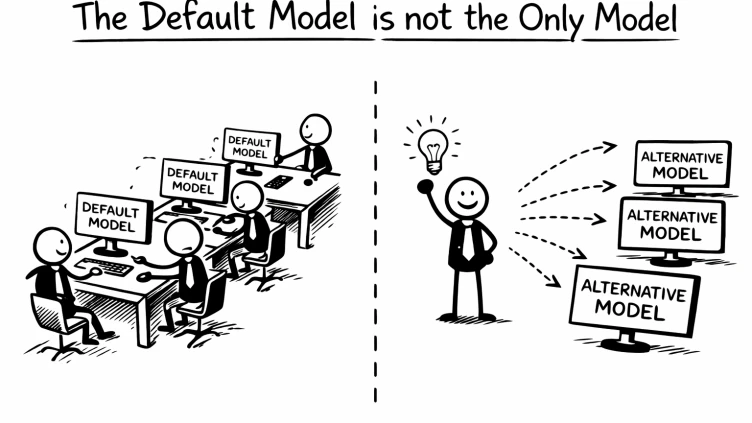
Discovery runs until there is a candidate. The candidate gets handed to development. Development runs until there is a process. The process gets handed to manufacturing. Manufacturing runs until there is a drug product. The drug product gets handed to clinical.
Four functions. Three handovers. One org chart that everybody can understand in a single slide.
The default model is not a mistake. It was a deliberate design choice made when capital was abundant, timelines were forgiving, and specialization was the easiest way to manage complexity. At the time, it was the right answer. It is also the model that 80% of biotech companies still run today, for the simple reason that nobody has made a compelling case to run anything else.
This article is the compelling case.
Or, I hope, at least the beginning of one.
Why the Default Model Is Under Pressure
The default model has one structural weakness that everybody feels and almost nobody names.
Every handover is a reset.
Context gets lost. Assumptions get reinterpreted. The original intent of the science gets diluted as it moves function to function, and by the time the molecule reaches the people who have to make it at scale, half the important decisions have been re-litigated twice.
The organization compensates the only way it knows how. More meetings. More reviews. More alignment. None of which actually restore what was lost, which is why the meetings never seem to end.
When capital was cheap, that waste was tolerable. The company could afford to rediscover the same problem in three different rooms because there was runway to absorb it.
That world is over.
Runway is tighter. Investors are pricing risk harder. The tolerance for rediscovery, for re-alignment, for the polite ritual of three functions solving the same problem in parallel, has collapsed. The default model still works. It just costs more than it used to, and the companies paying that cost are starting to notice.
The Modality That Broke the Model
There is one more reason the default model is under strain, and it deserves naming directly.
For small molecules and most biologics, there is a legitimate conceptual separation between the molecule and the process that makes it. The molecule is the product. The process is the method. You can argue about them separately, which is the philosophical basis of the handover model in the first place.
In cell and gene therapy, that separation collapses.
The process is the product. A change in the cell expansion protocol is a change in the drug. A change in the vector production step is a change in the therapy. Comparability is not a regulatory exercise you run at tech transfer. It is the central scientific question of the entire program from the first experiment onwards.
Which means the default model was not just slow for CGT companies. It was structurally incoherent. You cannot hand a finished molecule from research to development because there is no finished molecule. There is only a process, and whoever owns the process owns the product.
CGT companies figured this out quickly, because the alternative was scientific nonsense. What looks like innovation in those organizations is often just pragmatism. They collapsed their boundaries not because they were visionary but because the modality refused to cooperate with anything else.
The point is not that every biotech company should operate like a CGT company. It is that an entire segment of the industry has already stress-tested the alternative model under genuine duress, and there are things which are backward compitable.
What a Different Model Looks Like
The companies that are quietly compressing timelines are not working harder than everybody else. They have made a different design choice.
They have stopped treating their functions as stations on an assembly line and started treating them as participants in a shared problem.
That sounds like consultant-speak. It is not. It has a specific operational shape.
They develop the process once, not twice. One CTO I spoke to described the old approach as "developing a research process, then developing a manufacturing process, then spending eighteen months arguing about which one is real." His team stopped doing that. They developed a single process from the start, with both research and CMC in the room, and accepted that the early decisions would be slightly slower because more people had to agree. The payoff was that the late decisions stopped happening at all. The work that used to be rediscovered at tech transfer had already been done.
They run weekly cross-functional standups on the actual data. Not summaries. Not slide decks prepared in advance by someone who was trying to look good. The raw data, presented by the people closest to it, with all the other functions in the room. What is happening. What is stuck. What needs to move. It sounds unstrategic. It turns out to be the single most strategic thing most leadership teams can do, because it collapses the asymmetric visibility that causes most silos in the first place.
They send researchers to the CDMO. Not to execute. To watch. To stand next to a bioreactor and see, with their own eyes, what happens to a molecule they chose eighteen months ago. Nobody who has watched a cell line fail at scale designs the next one the same way.
They put CMC in the room at candidate selection. Not to vote. Not to veto. To ask one question. "If we pick this one, here is what the next three years look like. If we pick that one, here is what the next three years look like. Does that change anything?" Sometimes it does. Sometimes it does not. Either way, the decision got made with the end in view.
They bring clinical pharmacology into the conversation early. Formulation, dose, PK targets, bioavailability, and bridging strategy drive more CMC decisions than most CMC leaders want to admit. A low-dose, highly potent molecule has fundamentally different manufacturing economics than a high-dose one. A half-life target that shifts mid-program can invalidate months of formulation work. A bridging study assumption that changes late can blow up a comparability package that was already signed. In the default model, clinical pharmacology is a downstream input that CMC inherits, usually around the time it is too late to do anything useful with it. In the alternative model, clinical pharmacology is a voice in the room when the decisions that anchor everything else are still being made. That single change prevents more rework than almost any other upstream intervention.
None of these changes are structural. Nobody needs a new org chart. Nobody loses their function. The walls stay where they are. What changes is the timing of the conversations that happen across them.
The Leadership Shift the Alternative Model Requires
Here is where this gets uncomfortable for the people who have to run it.
The default model rewards functional leaders. People who own their scope, deliver on their targets, and stay out of everybody else's lane. The biotech industry has spent forty years training senior operators in exactly that posture, and it is the reason most CTOs are very good at what they do.
The alternative model rewards something different. It rewards leaders who identify with the asset rather than with the function. Who stop optimizing for "the CMC scope delivered on time" and start optimizing for "this therapy reaching patients faster than any version of us has ever done it before."
That sounds like a small shift in framing. It is not. It is a different job.
The leaders I have watched make this transition well share a few traits.
They ask different questions in meetings. Not "is this process robust" but "what does this decision do to the timeline, not just the process." Not "is this method validated" but "what does this design do to the capital, not just the manufacturability." Not "is the comparability package holding" but "what does failure here do to the valuation, not just the data integrity."
They stop optimizing for technical correctness alone. They start optimizing for trajectory.
And that shift almost never comes from inside the function. It comes from exposure. Sitting with the CFO and actually learning how the money moves. Listening to how investors interpret risk. Watching, up close, how a board translates a six-month delay into a discount. Not because the CTO wants to become a banker, but because without that lens the CTO is partially legible in the room where the company's future gets decided.
None of this is a criticism of functional leaders. It is a description of a choice leaders can make when the moment asks for it.
The Boundary Problem That Is Not an Ego Problem
There is a version of this conversation that gets framed as ego.
The CSO wants to own the science. The CTO wants to own the process. The clinical lead wants to own the patient experience. Everyone has a flag, nobody is willing to move it, and the deadlock gets blamed on personalities.
That framing is almost always wrong.
The issue is not ego. It is boundary.
Functional leaders are trained, rewarded, and promoted for owning their function. When an enterprise decision arrives that requires them to loosen their grip on the thing they have been accountable for, the instinct to protect it is not arrogance. It is conditioning. Forty years of career architecture cannot be undone by one offsite and a new set of values posters in the hallway.
The alternative model does not ask leaders to abandon their function. It asks them to hold the function a little less tightly and the asset a little more tightly, and to accept that the two can coexist.
The leaders who manage this shift tend to have one thing in common. They have been through enough organizational turbulence to know that their identity cannot depend on a single box on the org chart. That is not a skill you can teach in a workshop. It is something you pick up by surviving a few rounds of restructuring and noticing, on the other side, that you are still you.
Which, as career development plans go, is not the one HR would choose. But it is the one that works.
And Then There Is Quality
Every conversation about collapsing boundaries eventually runs into Quality, and it should.
Quality is the function most philosophically opposed to loosening anything. Their job is to enforce boundaries. To say no when the rules are not met. To maintain the separation between what is good enough and what is not. In the default model that posture is clean. Quality sits at the gate, inspects what comes over the wall, and signs, or does not sign.
The alternative model asks something harder of them. Not to stop enforcing. To change the timing and the shape of the enforcement.
The best Quality leaders I have worked with have figured out the distinction that matters. They stay absolutely uncompromising on the things that actually protect patients and data integrity. GMP. Validation. The rules that are not negotiable because they exist for reasons written in blood. And they become surprisingly flexible on everything else. When they get involved. How they communicate risk. Whether they own a decision outright or shape it from inside the room.
That adaptation is not easy. It cuts against forty years of Quality culture which has rewarded the people who hold the hardest line, not the people who hold the right one. The Quality leader who can tell the difference between a principle and a habit is rare. The ones who can do it under pressure are rarer still.
And they are exactly the Quality leaders the alternative model cannot function without. A Quality function that cannot adapt becomes the bottleneck that proves the default model was right all along. A Quality function that adapts well becomes the thing that makes the alternative model actually safer than the default, because the enforcement is happening earlier and more continuously rather than at a single gate at the end.
The invitation to Quality is not to dilute. It is to be principled about fewer things and present for more of them.
That is a much harder job than the one the default model asked them to do. It is also the one the moment is asking for.
What the Case Looks Like for Three Different Seats
Because the case for a different model lands differently depending on where you are sitting, it is worth being specific.
For the sitting CTO. The question is not whether the default model is wrong. It is whether the default model is still the right one for the stage your company is in. If you are approaching Phase 2 with a runway that will not survive a failed tech transfer, the math on integration has probably already moved in your favor. The first experiment is cheap. One weekly standup with research, CMC, clinical pharmacology, quality, and translational, looking at the same data, for thirty days. See what happens. If nothing changes, you have lost two hours a week. If something does, you have discovered leverage.
For the aspiring VP. The case for a different model is also the case for a different kind of career. If you want to be the CTO in five years, the people promoting you are looking for the candidate who can already talk about timeline, capital, and trajectory, not just process. Start building that vocabulary now. Ask your CFO for thirty minutes. Ask your clinical pharmacology lead to walk you through how dose decisions get made. Ask to sit in on one board meeting. Volunteer for the cross-functional work nobody else wants. None of this requires permission from above. All of it will be visible to the people who decide what you become next.
For the CEO. The question is the one you probably do not want to ask out loud. Is your current CTO a functional leader running the default model, or an enterprise operator running something else? Both are legitimate. Both can be excellent. They are not the same job, and the wrong fit between the stage your company is in and the posture of the leader in the seat is one of the most expensive mistakes you can make. The diagnostic is not complicated. Listen to the questions they ask in your next leadership meeting. If every question is about their function, you have a functional leader. If the questions are about the asset, the timeline, and the capital, you have something else. And if your Quality lead is fighting every request to adapt, you have a Quality function running the default model whether you asked for that or not.
Neither answer is bad news on its own. Mismatched to the stage is bad news. Matched is a competitive advantage.
Speed Is Not Something You Demand
There is a version of biotech leadership that still believes speed comes from pressure. Push harder. Hire more. Add oversight. Demand more frequent updates. That version tends to burn people out while the timelines quietly drift anyway.
The alternative is less visible. It looks like integration. Shared context. Clinical pharmacology and CMC in the same room. Quality leaders who know when to adapt and when to stand firm. Researchers who have actually seen a process fail at scale. Leaders who understand how science, operations, and capital actually intersect, and who have stopped treating each other as receiving departments.
Speed, in the end, is not something you demand from the system.
It is something the system either allows or resists.
Most companies are still running the default model. A smaller number are running something else. Both are legitimate choices. The question worth asking is which one you are running, and whether you are running it deliberately.
Because the most expensive version of the default model is the one nobody ever actually chose. It is just the one that accumulated.
Where Phase 3 Search Comes In
We spend our days placing CMC, technical operations, quality, and manufacturing leaders into venture-backed biotech companies, and the pattern we keep seeing is the one this article is about.
Some of our clients are running the default model beautifully and need a strong functional CTO to keep it running. Others have decided the default is no longer fit for their stage and need a different kind of leader in the seat. Both are real. Both are placeable. The mistake most companies make is assuming they need one when they actually need the other.
If you are looking at a timeline that is slipping, a board that is asking questions you are not sure how to answer, a Quality function that is fighting every request to adapt, or a CTO hire you cannot quite define, that is the conversation we exist to have.
Not to tell you the default model is broken.
To help you decide, deliberately, which model you want to be running.
If this is your discipline, let's talk.
Every engagement begins with a diagnostic — a structured read on the role and the company you are actually inheriting.
Start a diagnostic How we search →