
CMC Used to Be a Tomorrow Problem. The FDA’s 2026 Trial Reforms Make It a Today Problem.
TL;DR
Three FDA trial reforms have collapsed the historical sequence between clinical and CMC. The Single Pivotal Trial default standard (February 2026), the Flexible CMC Approach for cell and gene therapies (January 2026), and the Decentralized Clinical Trials final guidance (September 2024) each move CMC decisions earlier in the program. Together they raise the criticality of the function.
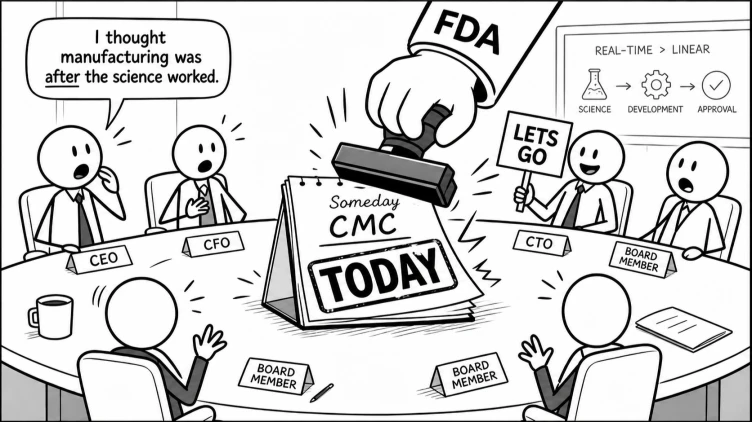
In yesteryear CMC was a tomorrow problem -- the package that followed clinical readout. Now the FDA has made it a today problem.
Read on for what each reform does to the timeline, the sequencing risks each opens up, and the structural moves a CTO can make to operate in today-mode.
“Let’s revisit the CMC plan after we see Phase 2 data.”
That sentence is the operating definition of CMC as a tomorrow problem. The sequence was the right answer to the regulatory environment that existed pre Sept 2024, and it's slowly become more and more outdated as the FDA has pushed through trial reform.
What changed
Walking backward from the most recent change to the regulatory environment.
March 2026: The Real-Time Clinical Trials initiative
The most recent FDA move, announced in 2026, takes the agency toward continuous clinical trial data submission and real-time review. The historical pattern of clinical data submitted in batches at defined milestones gives way to a continuous flow into the agency, with reviewers engaging with the data as it arrives rather than at scheduled intervals.
The implication for CMC is one of cadence rather than structure. As clinical data flows continuously, the CMC data that supports the clinical record -- batch release, stability, process performance, comparability outcomes -- has to flow at the same pace. Quarterly CMC summary reports lag the clinical cadence and create asymmetry the agency notices. Weekly is the new baseline. The function does not change shape under this initiative, but it loses the option to operate on a slower clock than the trial it is producing material for.
February 2026: The Single Pivotal Trial default standard and the Plausible Mechanism Framework
The clinical investigation phase compresses. The CMC dossier carries more of the weight of the approval, because the FDA is approving on less clinical replication. The agency’s own guidance language pushes sponsors to discuss CMC plans with the review division early in development. CMC strategy moves from a back-end deliverable to a front-end input. The decisions that used to wait for pivotal data now have to be made before the pivotal trial design is locked.
January 2026: The Flexible CMC Approach for cell and gene therapies
The agency expects a CMC conversation that starts in early-phase manufacturing and continues through post-approval revisions. Permissive investigational specifications are not a dispensation. They are an invitation to a continuous dialogue. The CMC timeline starts on day one of the program and does not end at filing. Companies that read the flexibility as deferral are reading it backward.
September 2024: The Decentralized Clinical Trials final guidance
Sponsor responsibilities for investigational product shipping, qualification of contracted service providers, written data management plans, and safety monitoring under distributed conditions all become live during trial conduct. They are not reconciled at filing. They are audited in real time. Drug product handling is now a regulated activity inside the trial, not a logistical layer outside it.
Each one reduces a different traditional barrier and replaces it with a continuous obligation. Each one moves work that used to live in the future into the present.
Sequencing risks
For each reform, a specific timing risk is now larger than it was a year ago.
CMC sequencing risk
This comes from the compressed clinical phases of the Single Pivotal Trial standard. Companies that plan to lock the process after pivotal data will arrive at filing with an under-developed CMC story. The agency’s flexibility on number of trials does not extend to flexibility on CMC defensibility. A single pivotal trial is harder to defend with a thin CMC package, not easier. The delay that follows is born from a sequencing assumption that no longer holds.
Comparability risk at scale
The flexibility offered on early-phase specifications is a gift only if the company demonstrates, at filing, that the commercial process is comparable to the process that produced the clinical data. Companies that take the relaxed early-phase posture without building a comparability strategy in parallel will discover at BLA stage that they cannot bridge the gap. Work that should have been done today gets pushed to tomorrow, when there is less time to do it.
Governance risk
Post-approval revision flexibility creates this exposure. The agency now expects an ongoing dialogue about manufacturing changes after approval. Boards that treat CMC as a one-time approval milestone will be surprised by the cadence of post-approval CMC decisions, each of which can affect label, supply continuity, and the cost of goods. The risk is decisions made operationally that should have been made at the board level, surfacing only when the next supply disruption or label revision lands.
Supply chain audit risk
Decentralized trial obligations are the source. The agency expects sponsor-side records of every contracted service provider, qualification documentation, and data flow mapping during the trial, not after it. Most CMC organizations do not have these records ready in the form the agency expects. The risk is a clinical hold or a finding at pre-approval inspection driven by gaps in the network of vendors handling investigational product, not by the product itself.
Dossier coherence risk
Real-time clinical trial data integration drives this one. As clinical data flows continuously, CMC release data, stability trends, and process performance must align with the clinical timeline in a way that supports continuous review. Companies whose CMC reporting cadence is quarterly will lag the clinical cadence and create asymmetry the agency notices.
Each one is a sequencing risk. Each one converts CMC from a tomorrow problem into a today problem.
Where dual fluency comes in
Dual fluency is about making the case and being heard. The environment has shifted toward CMC, not away from it. The reforms are validation. The function has been pulled forward, and the case the CMC community has been making for years now needs to be heard in the rooms where capital is allocated.
Dual fluency operates as a translation chain. Just as the CEO has to be dually fluent in front of the board by carrying the science into a language the board uses to allocate capital, the CTOQ has to be dually fluent in front of the CEO. The CTOQ’s job is to give the CEO translated talking points the CEO can take to the board: a comparability outcome rendered as runway months, a CDMO capacity reservation rendered as filing date probability, a stability signal rendered as cost of goods. If the CTOQ is invited to present directly, the translation happens at the table.
David Crean argues, in a recent Cardiff Insights essay, that the ability to operate credibly in the language of rigorous science and the language of investment value, simultaneously, is the single most underrated determinant of biotech success. Crean’s markers translate cleanly onto the CTOQ version of the role: translate without dumbing down so the science and the financial implication both stay intact; handle uncertainty with precision so deviation rates and comparability outcomes become runway months and filing date probability without false precision; connect mechanism to milestones so every CMC decision is tied to a financing event, an FDA interaction, or a supply continuity assurance; equip others to retell the story so the CFO can defend the CMC thesis without the CTOQ in the room.
That set of competencies is what closes the timing risks the FDA has just opened up.
How CMC needs to be supported
Each move below is about supporting CMC to operate in today-mode. The CTOQ/Head of CMCQ does not close these risks alone. The CEO and the board build the structure that makes the work possible.
1. Governance:
Start with governance. The board reviews material CMC decisions on a defined schedule, with the CTO presenting the trade-offs in the language the board uses to allocate capital: cost of goods impact, label implications, supply continuity, and capital allocation. Today-mode governance, not after-the-fact reporting. This is the foundation. Without board-level cadence, every other support move erodes within a quarter.
2. Move CMC Upstream
Get the CTO in the room when the trial is designed. The CMC plan is an input to the clinical development plan, not a downstream consequence. The CTO is at the table when the trial design is set, translating CMC sequencing implications into clinical timeline, runway, and approval probability before the design is locked. This is where most companies bleed the most time. The trial design closes before CMC has had a chance to shape it.
3. Comparability
Build comparability strategy from day one. The bridge to commercial is built starting on day one of manufacturing, not after pivotal. Bridging studies and analytical method development are scheduled into the early-phase plan, not deferred to the late-phase scramble. This protects the company’s ability to use the FDA’s flexibility on early-phase specifications without inheriting the comparability problem at BLA.
4. Prove CDMO Maturity
Build the contracted service provider audit file before the agency asks for it. The file exists in current form on the day a pre-approval inspection notice arrives, not in the weeks after.
5. Reporting Cadence
Synchronize CMC reporting cadence to clinical reporting cadence. CMC data is summarized for leadership weekly, not quarterly. The CTOQ is in the room when the clinical update is delivered to the board, presenting the integrated picture.
6. Translation
Hire and structure the function for dual fluency. Technical depth is the foundation. Financial and regulatory translation is what makes the role visible at board level. A CTOQ who can carry CMC data into the board room as a value narrative, and who can subject the value narrative to technical scrutiny without breaking it, is the CTOQ the new regulatory environment now requires.
How the board can test for reform compliance
Pull up the last three board materials. Find every reference to FDA regulatory strategy. Now find every reference to CMC strategy that reflects the reforms of the last twenty months.
FDA regulatory strategy and CMC strategy must match. They are no longer separate columns on the agenda. If the board is reviewing one without the other, the company is operating on a structure the agency has already changed.
The board has to support CMC for the company to be ready to take advantage of the new flexibility. That support is not optional under the new regulatory environment. Resources, governance cadence, reporting line, board access, and the freedom to hire for dual fluency all have to be in place before the next financing event.
Fundamentally, it is our patients who need companies to adapt. The reforms exist because faster, better-aligned development means therapies reach patients sooner. A board that does not adapt is not just leaving valuation on the table. It is leaving therapies on the bench.
Close
The agency made these reforms because biotech is moving faster than the old timing model could regulate. The companies that move with the agency will benefit from the new flexibility. The companies that keep treating CMC as a tomorrow problem will discover the cost in the next round of diligence.
David H. Crean, Ph.D. is right that dual fluency separates the leaders who get funded from the ones who get forgotten and the FDA’s recent posture has made dual fluency a structural requirement of the CTO role today, not an aspirational target for tomorrow.
Phase 3 Search has since published the CTO Mandate Framework, designed to help boards and CEOs tackle exactly this problem.
References cited in this article: David Crean, Cardiff Insights, “Dual Fluency: The Two Languages Every Biotech CEO Must Speak,” May 2026 (davidhcrean.substack.com/p/cardiff-insights-dual-fluency). FDA Single Pivotal Trial default standard and Plausible Mechanism Framework draft guidance, February 2026. FDA, “Flexible Requirements for Cell and Gene Therapies to Advance Innovation,” January 11, 2026. FDA, “Conducting Clinical Trials With Decentralized Elements,” final guidance, Federal Register, September 18, 2024. FDA, “Major Steps to Implement Real-Time Clinical Trials,” 2026.
If this is your discipline, let's talk.
Every engagement begins with a diagnostic — a structured read on the role and the company you are actually inheriting.
Start a diagnostic Our CTO & technical leadership practice →