
No One Is Building the CMC-to-Boardroom Curriculum. So You'll Need to Build It Yourself.
TL;DR:
The industry is making the case for CMC expertise in the boardroom. The good news: the hardest part, the deep technical knowledge, is already there. The bridge is learning the language of capital, risk, and enterprise decision-making. And that bridge is shorter than most CMC leaders think.
The last article in this series made the case for CMC expertise in the boardroom.
This one asks a different question: How the CMC community need to prepare to step into that role?
The foundation is already solid. The depth of knowledge that senior CMC, QA, and technical operations leaders carry is exactly what boards are missing. Manufacturing-category deficiencies account for the majority of recent CRLs. Process robustness, comparability strategy, CDMO governance, analytical method lifecycle — these are the domains where enterprise value is most vulnerable and least governed.
What is missing is the translation layer.
And that layer is buildable.
The Translation Problem Is Real — And It Runs Both Ways
Boards have been ignoring CMC risk because no one in the room speaks the language. That much we covered.
But the other half of the equation deserves equal honesty: most CMC leaders have never been given the opportunity to learn how boards think.
This is not a gap in talent. It is a gap in the system.
The career path for technical operations leaders in biopharma is almost entirely execution-oriented. You build processes. You manage CDMOs. You navigate regulatory complexity. You solve problems that would make most commercial executives weep quietly into their coffee.
What that path does not include, at any stage, is formal education in how boards think, how capital decisions get made, or how to translate technical conditions into enterprise risk.
Boards think in probability of outcome, timeline impact, capital exposure, and decision points.
Technical leaders think in process robustness, method lifecycle, comparability risk, and vendor dependency.
These are not the same language.
The CMC leader who walks into a board discussion and presents a deviation trend analysis when the board needs to hear "there is a 30% chance our filing shifts nine months and costs an additional $8M" has not failed at their job.
They just have not yet been shown the bridge between the two languages. And that bridge is entirely learnable.
What Board Readiness Actually Means
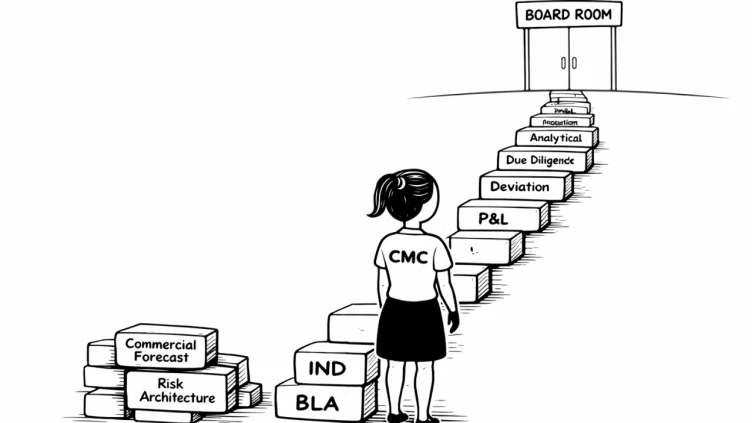
Board readiness for CMC leaders is not about learning to make slides. It is about developing fluency in four domains that the traditional technical career path does not teach.
1. Capital Logic
Every board decision is, at its core, a capital allocation decision.
CMC leaders who want board-level influence need to understand how funding rounds work, what investors are actually pricing when they evaluate a pipeline, and how technical risk translates into valuation.
This means understanding that a $3M investment in process characterization is not a cost center. It is insurance against a $15M remediation that would arrive at the worst possible time in the financing cycle.
It means being able to articulate why dual-sourcing a critical raw material is a capital efficiency argument, not a supply chain argument.
The good news: if you already understand why that investment matters technically, you are 80% of the way there. The last 20% is learning to say it in a language the CFO already speaks.
2. Deal Evaluation
As biopharma matures, the CMC leader's strategic value extends well beyond manufacturing.
Large pharma now sources over 70% of new molecular entity revenues externally. Every acquisition, every licensing deal, every partnership carries technical risk that most deal teams are not equipped to evaluate.
A board-ready CMC leader can look at an inbound asset and ask the questions that deal teams miss: Is this process reproducible at the acquirer's scale? What does the comparability strategy assume? How mature are the analytical methods? What would a pre-approval inspection find?
These are not due diligence questions.
They are value questions. The ones that determine whether an acquisition creates value or inherits a CRL.
3. Risk Architecture
CMC risk does not behave like clinical risk. Clinical risk has clean milestones — data readout, FDA response, go/no-go.
CMC risk accumulates as conditions.
A board-ready CMC leader understands this distinction and can present technical risk the way boards need to receive it: with probability, timeline impact, and capital exposure.
Not "we have some comparability concerns."
Instead: "There is a meaningful probability that our filing timeline shifts six to twelve months if this is not resolved, and the cost to resolve it post-hoc is three to five times what it would cost now."
That framing is not where most technical leaders start. But it is absolutely where they can get to.
And it is the difference between being heard and being humored.
4. Governance Instinct
Boards do not manage operations. They govern risk.
That distinction matters.
A board-ready CMC leader knows the difference between presenting a CAPA trend and surfacing an enterprise risk. They know when to escalate versus when to manage. They understand that the CTO's relationship with the board should be an independent information channel — not because the CEO is untrustworthy, but because narrative incentives structurally filter operational reality before it reaches the boardroom.
The most effective CMC board members I have observed share a specific trait: the willingness to name uncomfortable operational realities at moments of maximum narrative pressure.
When everyone in the room wants to believe the submission is on track, they are the ones who say "here is what the deviation backlog actually tells us."
That is not adversarial.
That is governance.
The Education Gap — And Why Closing It Starts Earlier Than You Think
Here is something the industry does not talk about enough: board readiness is not a late-career pivot. It is a trajectory that starts at the Director and VP level, and it starts with choices you make yourself.
The biotech industry has robust professional development for clinical leaders. There are courses on regulatory strategy, clinical trial design, and FDA interaction. Medical affairs has its own conference circuit. Commercial leaders get trained on launch planning and market access from the moment they enter the function.
CMC and technical operations leaders get almost none of this at the governance level.
The education that exists is technical: process development, analytical chemistry, regulatory CMC. All of it necessary. None of it sufficient for the boardroom.
What is missing:
How to read a term sheet and understand what it means for technical infrastructure investment
How to evaluate an acquisition target's manufacturing readiness as a strategic input –
How to present technical risk in financial terms that boards can act on
How to participate in a governance discussion without defaulting to an operations update
How to think about the CTO role as a portfolio of enterprise risk functions, not a manufacturing checklist
And here is the part that matters most: no one is going to build this curriculum for you. Not yet. The industry has not caught up. Which means the onus is on the individual CMC leader to seek out the exposure that their career path does not provide.
That starts now. Not when you are being considered for a board seat. Not when you make SVP. It starts the moment you decide that your career trajectory extends beyond operational excellence.
Read the proxy statements. Sit in on investor calls. Ask your CFO to walk you through how the board evaluates capital allocation. Understand what your company's investors are actually looking for when they ask about "CMC readiness." Volunteer for the cross-functional task force nobody else wants. Ask to sit in on a board meeting as an observer. When the M&A team is evaluating an inbound asset, raise your hand and offer the manufacturing lens.
Every one of these is available to a motivated Director or VP right now — without anyone's permission.
Some of the development requires more structured support. Board observer roles. Advisory positions with real access. Mentorship from experienced board directors who understand technical operations. But the initiative to seek these out has to come from you.
The CMC leaders I have seen make this transition successfully share one trait: they did not wait for the industry to create a path. They built one, by being curious about the business side of biopharma long before anyone asked them to be.
The companies that support this development are not just building better CMC leaders.
They are building the pipeline of board-ready technical talent that the industry desperately needs.
But the companies cannot want it more than you do.
The Structural Opportunity
Here is where the momentum is real.
Recent FDA data shows that manufacturing facility deficiencies are the most commonly cited CRL category, affecting 65% of recent novel therapeutic CRLs. CMC deficiencies followed at 51%. The median time from CRL to approval is 1.28 years.
Every one of those delays is a therapy patients cannot access. Every one of those delays is capital destroyed at the point of maximum exposure.
Boards are beginning to understand this. Investors are beginning to ask different questions. Tools like RA Capital's Gateway are emerging to help companies build boards with broader functional expertise.
The demand side is shifting.
The question is whether the supply side, the CMC community itself, is ready to meet it.
A Note to the CMC Community
This article is written as much for you as it is for the boards and investors who read this series.
The case for CMC expertise in the boardroom has been made. The data supports it. The governance logic supports it. The patient impact demands it.
The door is opening. But no one is going to push you through it.
Board readiness is a choice you make — at the Director level, at the VP level, at every stage where you decide whether to stay inside the technical lane or start learning the language of the room where decisions get made.
Not abandoning what got you here. Building on it.
The CMC leader who can run a flawless tech transfer and present a risk-adjusted capital argument for why it matters is the one who changes what boards are able to see.
And changing what boards can see is how we prevent the CRLs that should never have happened — the ones that were not clinical failures, but governance failures.
The gap is closable. The foundation is already yours.
The question is whether you start building on it now.
Where Phase 3 Search Comes In
We spend our days at the intersection of technical leadership and board-level governance in biopharma. Sometimes that means placing the CTO or SVP who can build the translation layer between operations and the boardroom. Other times it means helping companies identify experienced CMC operators for advisory or board-adjacent roles, people who have already made the leap from operational excellence to governance fluency.
Increasingly, we are also working with CMC leaders earlier in this transition — helping them understand what boards actually need, what the governance gap looks like from the other side, and how to position themselves for the board-level influence their expertise warrants.
The companies that build this pipeline do not just close the governance gap.
They build boards that can see around corners.
And in an environment where manufacturing-category CRLs remain the most common approval blocker and funding has never been tighter, the ability to see around corners is not a luxury.
It is how therapies reach patients.
If this is your discipline, let's talk.
Every engagement begins with a diagnostic — a structured read on the role and the company you are actually inheriting.
Start a diagnostic Our CTO & technical leadership practice →