
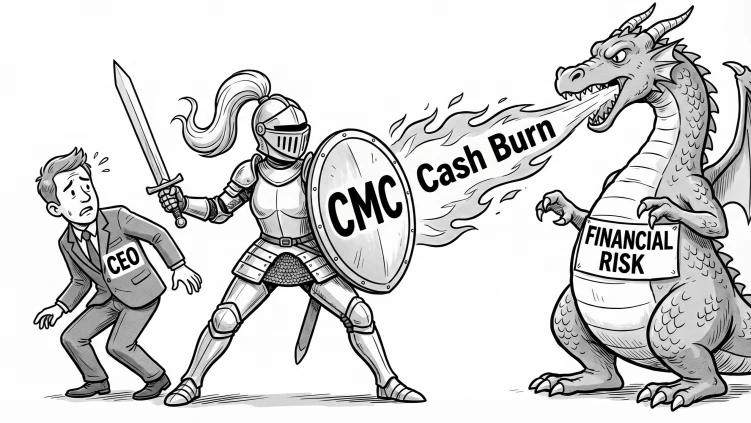
This Is Why CMC Is the CEO's Greatest Ally...
TL;DR
Manufacturing or quality-related regulatory delays cost $5-10M per month in cash burn, with first-time launchers averaging 2.5 years to resolution. Most trace back to early development decisions made without CMC expertise in the room. A tenured CMC leader positioned upstream can prevent $40M to $125M in avoidable spend on a single program. But unlocking that value requires the CEO to assist manage the politics that keep R&D and CMC separated.
If a leader walked into the CEO's office and said "I can extend your cash runway by eight months," they would clear their calendar.
If that same leader said "I can reduce your probability of a filing delay by half," they would give them whatever resources they asked for.
That leader is a company's CTO/Head of CMC. And in most biotech companies, they are not positioned to do either.
A note on scope: when this article refers to CTO it should also be read as Head of CMC. When this article refers to CMC, it includes technical development (process development, analytical sciences, formulation) and the full chain of activities that translate a molecule into a manufacturable, inspectable product. In many organizations these functions sit under different names and reporting lines, but they represent a single continuum of work. Separating them organizationally is part of the problem this article describes.
The Silo Tax
Most biotech companies organize R&D, technical development, CMC and Quality as separate functions with separate reporting lines and, critically, separate decision timelines. Research sets the molecular design. Process development builds the manufacturing process. Quality and CMC inherit both and figure out how to make it work at scale, in compliance, under inspection.
It's the structure that many saw growing up at Big Pharma. It was effective. It is also expensive.
When CMC and quality expertise is not in the room during early development decisions, the decisions still get made. They get made by research scientists optimizing for efficacy, by clinical pharmacology teams making formulation decisions based on PK targets without accounting for manufacturing scalability or stability at commercial storage conditions, by process development teams optimizing for speed to the next milestone, by program leaders optimizing for the investor update. All rational priorities. All creating manufacturing and quality constraints that the downstream teams will spend months, sometimes years, working around afterward.
That workaround time is the silo tax. It shows up in specific, predictable ways. Process changes late in development trigger comparability studies that add six to nine months. Analytical methods designed for early-stage speed but not for CDMO transfer require four to six months of revalidation. Tech transfer timelines slip because the process was never characterized with commercial-scale parameters in mind. Pre-approval inspection readiness gaps surface twelve months before filing and require remediation that consumes the entire window.
Each of these is avoidable. Not every time, but far more often than most CEOs realize. And each one burns cash on a problem that was designed into the product rather than discovered during manufacturing or quality review.
What Moving CMC Upstream Actually Saves
A typical Phase 2-3 biotech burns $5-10M per month in operating costs. A manufacturing or quality-related regulatory delay (whether a clinical hold, an inspection finding, or a remediation cycle) averages 12 to 18 months for companies with experienced teams and over 2.5 years for first-time launchers without previous commercial experience.
At $7M per month burn rate, a 12-month delay costs $84M in additional capital that was not in the plan. An 18-month delay costs $126M. A 2.5-year delay costs $210M. These are not edge cases. They are the median outcomes for companies that discover manufacturing and quality problems at the point of filing rather than the point of development.
A comparability study triggered by a late-stage process change typically adds six to nine months. If the CTO is in the room when the process is first designed, they flag the parameters that will require comparability if changed at scale, before the process is locked. That study never gets triggered.
An analytical method that was never designed for transfer to a contract manufacturing site can add four to six months of revalidation work. If the CTO ensures manufacturing-appropriate method design during early development, that revalidation never happens.
A CTO who drives the transition from research-use-only materials to GMP-grade reagents and reference standards early in development eliminates an entire category of regulatory pushback. When RUO materials persist into later-stage studies, the FDA will ask why, and the answer is never simple. Requalifying assays, revalidating methods, and demonstrating comparability between RUO and GMP-grade inputs can consume six months or more. Every data package generated with the original materials comes into question. The CTO who forces this transition early, when the cost is a line item rather than a program delay, saves the company months of remediation and a regulatory conversation no one wants to have.
A pre-approval inspection finding that traces back to insufficient process characterization can add twelve or more months of remediation. If the CTO drives characterization strategy from the beginning, the characterization is built into the development timeline rather than bolted on before filing.
Add those up. A CTO positioned upstream, with the organizational authority to influence development decisions, can realistically prevent 6 to 18 months of avoidable delay. At $7M per month, that is $42M to $126M in preserved capital. On a single program.
This means that CMC is not just a technical contribution. It is a financial one.
The CTO as Financial Ally
This reframe matters because of how most boards and CEOs currently evaluate the CTO role.
The typical assessment is technical:
Does this person understand manufacturing?
Can they manage CDMOs?
Do they have regulatory (NDA,IND, BLA) experience?
Those questions filter for competence. They do not filter for the capability that matters most at a company level, which is preventing avoidable capital destruction.
The CTO who can translate between R&D language and manufacturing and quality language, who can hear "promising efficacy data" and simultaneously hear "process scalability risk" and "comparability trigger" and "analytical method transfer challenge" and "quality system readiness gap," is not just managing technical operations. They are managing the company's most likely source of delay, rework, and unplanned capital consumption.
In cell and gene therapy, this dynamic is even more acute. Manufacturing and quality decisions directly affect clinical outcomes. A process change can alter potency. A scale-up modification can shift the product's therapeutic profile. Peer-reviewed data (Pietrusko et al., Therapeutic Innovation and Regulatory Science, 2023) found that 21% of cell and gene therapy clinical holds were CMC-attributed, with a mean duration of 8.4 months. At typical burn rates, that is $42M to $70M per hold in cash consumed while the company cannot advance its program. The CTO who prevents even one of those holds has already justified their compensation, their team, and their organizational position many times over.
The question boards should be asking is not "is our CTO technically qualified?"
The question is "is our CTO positioned to save us $50M or more in avoidable delay, and have we given them the organizational authority to do it?"
Why the CEO Has to Manage the Egos
If the financial case is this clear, why does the silo persist?
Because collapsing it requires the CEO to manage organizational politics that most companies prefer to avoid.
This is not a single-ego problem. The CEO is balancing the CSO who built the science and feels ownership over it, the CMO whose clinical pharmacology team made formulation decisions that now carry manufacturing consequences, the CTO who needs upstream access, and functional VPs across R&D and quality who each have legitimate claims on decision authority. Every one of those leaders has built credibility in their domain. None of them are wrong about their own function. But none of them are optimizing across the full chain from discovery to approvable product.
In many biotech companies, the culture prizes scientific discovery above everything else, and for good reason. The science is what creates the possibility. Adding CMC and quality voices to early-stage conversations, particularly when clinical pharmacology has already made formulation choices that carry downstream manufacturing implications, feels like second-guessing. It feels like manufacturing telling science what to do.
It is none of those things. But it will feel that way to the CSO, the CMO, and their teams unless the CTO & CEO frame it correctly and hold the line when the resistance shows up.
The framing matters enormously. "Manufacturing needs a seat at the table" sounds like a power grab. "We need to design products that are approvable, not just efficacious" sounds like what it is: a strategic upgrade that protects everyone's work. The CEO who frames integration as a shared mission rather than a territory concession is the one whose organization actually makes the shift.
The CEOs who do this well tend to make one thing clear to the entire leadership team: CMC not there to slow things down. CMC is there to prevent the kind of delay that costs $50M to $200M and one to three years. Given those numbers, an extra voice at the development table is the cheapest insurance the company will ever buy.
What Comes After the Silo Falls
When the CEO successfully collapses the silo between R&D and CMC, something changes in how the company operates and how it spends.
R&D, Clinical, process development, CMC, and quality stop functioning as a sequence of handoffs and start functioning as an integrated system. Development decisions account for manufacturing and quality constraints from the start. Process design includes commercial-scale parameters before the process is locked. Analytical methods are built for transfer, not just for early-stage studies.
The financial signature of this shift is predictability. Programs move through development with fewer rework cycles, fewer surprises at the point of filing, and a more predictable capital consumption profile. For companies approaching capital events, that predictability translates directly into investor confidence. Investors do not just price clinical risk. They price operational execution risk. And the company with an integrated development function prices better than the company with a downstream remediation plan.
The Conversation That Is Available
At your company, if your CTO walked into the CEO office tomorrow and said "I can save us $50M in avoidable delay, but I need a seat at the development table and I need you to back me when R&D pushes back," what would happen?
That conversation is available to every CEO who has a CTO with the experience to see across the R&D-to-manufacturing-and-quality boundary. It is available right now. But it requires the CEO to recognize that the CTO's value is not just technical. It is financial. And it requires the CEO to create the organizational conditions where that value can be realized, which means managing the egos, framing the mission, and holding the line.
This is the kind of leadership alignment that Phase 3 Search builds for. Sometimes that means placing the CTO who can collapse the silo and translate between R&D and the full CMC and quality chain. Sometimes it means helping a board understand why that role needs to be positioned upstream, not downstream, and what it costs when it is not. The companies that get this right do not stumble into it. They design for it.
The structural model for how this works, for how companies can close the gap between discovery and operations and capture the capital that is currently being burned in the silo, is coming on May 14th. More to come. If you want to talk to us before then, please reach out directly.
Sources
• 2.5-year average delay for first-time launchers: RSM US LLP analysis of FDA Complete Response Letter data, cross-referenced with Dilek et al. (2026), "Deficiencies Delaying Prescription Drug Approvals by the U.S. Food and Drug Administration, 2020-2024," Therapeutic Innovation and Regulatory Science (median CRL-to-approval of 1.28 years across 43 novel therapeutics).
• 21% of cell and gene therapy clinical holds CMC-attributed, mean duration 8.4 months: Pietrusko et al. (2023), Therapeutic Innovation and Regulatory Science (peer-reviewed).
• $5-10M per month burn rate: commonly referenced range for Phase 2-3 development-stage biotech companies based on industry financial benchmarks. Specific burn rates vary by modality, number of programs, and stage.
• 85% of small biopharma companies outsource API production; 77% outsource finished-dose manufacturing: William Blair 2024 analysis.
• Financial impact calculations ($42M-$126M avoidable spend) derived from burn rate range applied to preventable delay estimates of 6-18 months.
If this is your discipline, let's talk.
Every engagement begins with a diagnostic — a structured read on the role and the company you are actually inheriting.
Start a diagnostic Our CTO & technical leadership practice →