
CMC Is a Lever on Exit Multiple. Help to Build the Benchmark that Proves It.
By Alex Cooke | Phase 3 Search | June 5, 2026
TL;DR
CMC reaches the board as a status word with nothing to measure it against, so excellent and adequate look the same from the top. Like a CFO who lands a good price with no prior number on the table, excellent CMC earns no credit, and that is not only a recognition problem. Boards tend to fund visible acceleration more readily than invisible reliability, so quiet excellence goes underfunded while the bar it sets gets read as normal. Useful numbers do exist, but most are CDMO marketing, best-case, and clustered on a few modalities. What is missing is an independent, comparable, openly referenceable benchmark, built modality by modality and only across technologically similar assets, on non-confidential and sourced data. Impossible? No. If we can figure out how to insert, silence, or replace a gene to correct diseases that wiped out generations, then this benchmark is easy. However, we need to come together to get the method right. This piece is your invitation.
The problem
The leader who renegotiates a contract from two million dollars down to one and a half million walks into the next meeting to applause. Everyone can see the half million saved, because they can see the two million it started from. A different leader who simply lands the same contract at one and a half million from the start, with no prior number ever on the table, gets nothing. Same outcome. No benchmark, no applause. Sound familiar?
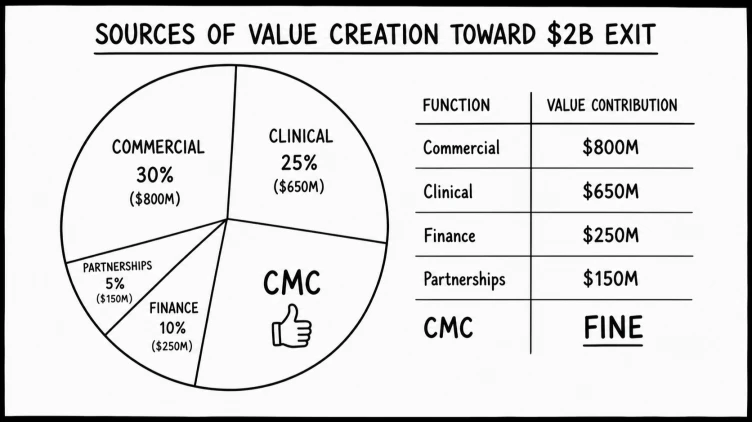
CMC lives permanently in the second version of that story. It is among the most operationally complex functions in a biotech, and one of the least legible by the time it reaches the board, where it arrives compressed into a single word. Ready. Fine. No flags. Behind that word sit a comparability strategy, an analytical method lifecycle, a tech transfer, a CDMO relationship, a deviation history, and a dozen decisions that each carried a timeline and a cost. The board does not have time to unpack it, the CEO usually cannot either, and the clinicians downstream do not care how the drug was made as long as it is there, on spec, when the patient needs it. So excellent and adequate report identically, and a function that carries an outsized share of the risk that actually blocks approvals gets none of the credit. Which raises two questions. Why are we not telling a more compelling executive story, and what would we need to shape one? My guess? One phenomenal benchmark.
Recognition is the visible cost. Funding is the expensive one
Over time, invisibility does something corrosive. Excellent gets recalibrated as normal, the standard keeps climbing, and everyone upstream perceives the new height as simply standard. The team that saved nine months by funding process characterization early gets the same nod as the team that deferred it and got lucky.
The sharper cost shows up at the next budget cycle. Boards and CEOs tend to fund accelerants. Put a program in front of them that visibly speeds something up, takes a quarter out of a timeline, opens a capability the company did not have, and the capital tends to appear. Steady, on-time, competent execution moves money less easily, because nothing about it reads as an opportunity. It reads as normal, and normal is hard to fund.
That is the trap a well-run CMC organization walks into. The better it performs, the more its performance looks like the baseline, and the harder it becomes to argue for the resources that keep it performing. Demonstration is what breaks the trap. If a CMC leader can show where comparable programs land and where theirs lands, the conversation moves from a status word to a number, and a number is something a board can act on. Every month a timeline slips is runway burned against a milestone not yet hit, and runway is the one resource a development-stage company never gets back.
The upside runs past the budget line, and it ends at the multiple. Trace the chain. A benchmark makes CMC's performance measurable. What can be measured can be valued, and what carries a defensible value can be sold. Anything sold for more than it cost to build carries a multiple above that cost. So a CMC organization a benchmark shows is consistently ahead of comparable assets reads as more than well run; it reads as a de-risked asset, and de-risking is what later capital pays a premium for. Today that premium is hard to claim, because the over-performance is invisible and therefore unpriced. Make it legible, and benchmarkable CMC stops being a cost line and becomes a lever on the multiple, at the next round and again at the exit.
The numbers exist. A benchmark you can trust does not
It would be wrong to say CMC has no numbers. It has plenty. A standard monoclonal antibody can move from DNA to IND in as little as six months on an accelerated platform, against a more conventional eighteen to twenty-four. The problem is where those numbers come from and what they cover. Most are published by the CDMOs selling the service, they describe the best case rather than the middle of the distribution, and they cluster on the few well-trodden modalities. Step from a standard antibody to a bispecific, an antibody-drug conjugate, or an autologous cell therapy, and the public reference points thin out fast.
The serious work that does exist tends not to resolve into something a board can use on a Tuesday. The industry consortiums that benchmark manufacturing produce maturity models and best-practice playbooks rather than timeline distributions. The most rigorous timeline studies sit inside paid diagnostics or academic cost analyses. What is missing is not the data but a way to trust it: an independent, comparable, openly referenceable benchmark, built so the people who publish it cannot bend the answer to suit themselves.
What the benchmark has to be
So here is what it has to be. Comparative, first: a reference that lets a board, a CEO, a CTO, or an investor look at a plan or an outcome and see where it sits against assets that are actually alike. That reference is the two-million number CMC has never had, and it would arm technical leaders rather than expose them. A strong organization could finally prove its quiet, on-schedule delivery was excellent. A struggling one would get an early signal before the cost of the gap compounds.
It has to respect comparability, which is the reason this has not already been built well. Not all modalities are equal, and a benchmark that pretends they are is worse than none. The CMC path for a monoclonal antibody does not resemble the path for an autologous cell therapy, which does not resemble an AAV gene therapy or an antibody-drug conjugate. Potency assay development can be a footnote for one and a program-defining bottleneck for another. The comparison has to go finer than modality, too. Only technologically similar assets are fair comparisons: an autologous ex vivo process against another autologous ex vivo process, a platform approach against a platform approach, not a living cell product judged against a well-characterized protein, and not a bespoke process measured against an industrialized one.
And it has to be clean. The benchmark will run on non-confidential information only. Every figure will carry its source. It will not be tuned to flatter anyone, including us. Data is data. The moment a benchmark bends toward the person holding it, it stops being a benchmark and becomes a brochure, and the field has enough of those already.
Why Phase 3 Search can build this
A fair question is why this should come from me. The owner of a search firm. The answer is that we have already shipped the harder version of it once. Three weeks ago we published the CTO Mandate Framework, a governance model for how boards should evaluate technical leadership across the stages of a company's life. We did not put it out as a think piece; it was a working instrument, built with CTOs who have run commercial launches between them.
The fairer question is what I get out of it, and a benchmark's credibility starts there, so let me name my own incentives. Phase 3 Search does not sell this. It is not a product, and neither contributing to it nor being measured by it buys anything from us or costs anything either. Do I benefit? Yes, just not directly. I run a search firm, and being the person who champions CMC and builds a useful tool for it is good for me. I will own that rather than pretend otherwise.
What pulls harder than the business case is simpler. I have spent fifteen years building relationships with technical leaders who belong at the board table and too rarely reach it, and I care, more than is probably sensible, about getting medicines to the patients waiting for them. A benchmark that makes CMC legible serves both. That is the bias I bring, and the data will not carry it, because the data is non-confidential and sourced and the method is open to exactly the scrutiny this paragraph invites.
What happened when we shipped the last tool is the part worth paying attention to. In under a month, the CTO Mandate Framework was downloaded more than 300 times, by 238 people across 221 companies. Around 147 of those companies are emerging biotechs, alongside roughly 30 of the largest names in pharma and a long tail of cell and gene therapy specialists, CDMOs, and advisors. Of the people, 56 are in the C-suite, 84 are VP or SVP, and another 69 are directors or heads of function, which puts about 140 of them at VP level and above. The names run from Merck, Regeneron, Gilead, Moderna, Alnylam, Bristol Myers Squibb, Takeda, Lilly, Sanofi, Roche, Vertex, Biogen, AstraZeneca, Novartis, AbbVie and Novo Nordisk through Sandoz and WuXi Biologics to dozens of clinical-stage biotechs and the advisors who serve them. That is not a readership we built. It is one that already existed and was waiting for someone to name the problem. We named five of them: Possible, Reproducible, Acquirable, Scalable, and Durable.
The benchmark is the next tool in the same project. Our commitment has always been to elevate CMC by building the things the field actually needs, not by floating a clever idea and walking away.
Help us build it
This is where I want company, and I want to be precise about the ask. It is not your confidential data. The benchmark runs on non-confidential, sourced information by design. What I am asking for is harder and more interesting than data: help us get the method right. What should it measure, milestone by milestone, so the numbers mean something rather than merely look tidy? Which disclosable sources are the good ones, and which are vendor gloss? Where exactly do you draw the line on technological similarity so a comparison stays fair? And what would make a board trust the reference enough to plan and fund against it?
If you have run these programs, sat in the CMC seat, priced this risk as an investor, or simply thought hard about the problem, those are your questions to argue with. Push on the methodology. Argue the boundaries. The instrument will be better for it, and you will have helped build the thing whose absence you have felt.
And if you want to see it built but have nothing to add yet, say so. Comment “Build it.” That is the whole ask, and it doubles as the first data point, because it tells me how many people have been waiting for this. If you have a second more, add the modality you would want benchmarked first. That tells me where to start.
Close
A function the board cannot measure gets treated as a commodity, and commodities get squeezed. You do not change that by asking a board to care more about manufacturing. You change it by giving them a way to see what good actually looks like.
There is a longer aim behind it. Until every biopharma board has a CMC leader sitting on it, the function will keep being read through a single quarterly word like “fine,” and the distance between what it delivers and what it is credited for will keep widening. That is as much a fight for recognition as it is one for resource allocation. The two are the same fight, because recognition is what unlocks the resource, and a benchmark is how that recognition finally becomes something a board can see. Something the board can value.
Reminder: Comment "Build It" below or DM me. I will follow up with you shortly afterward.
Sources and notes
Standard monoclonal antibody DNA-to-IND timelines (~6 months on accelerated CDMO platforms; ~18-24 months conventional): CDMO program disclosures, including Lonza Ibex Design and WuXi Biologics DNA-to-IND, 2024-2025. Existing benchmarking landscape referenced: BioPhorum technology-transfer best-practice and manufacturing maturity-model workstreams (member consortium); Tufts CSDD diagnostic and optimization (benchmarking) services; academic process-development and manufacturing cost benchmarking (e.g., PMC7531566). CDMO timeline figures are vendor-published best cases cited to illustrate that fragmented data exists, not as an independent benchmark. Download readership figures are Phase 3 Search internal data from the CTO Mandate Framework gated release, as of 9 June 2026.
If this is your discipline, let's talk.
Every engagement begins with a diagnostic — a structured read on the role and the company you are actually inheriting.
Start a diagnostic Our CTO & technical leadership practice →