
CMC Is Not a Cost Center. It Is an Exit Multiplier
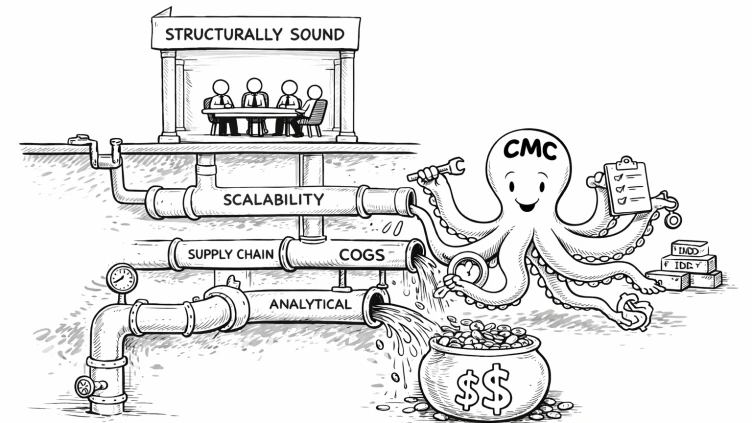
TL;DR: CMC is one of the most under leveraged driver of enterprise value in venture-backed biotech. The companies that treat it as an upstream investment — not a Phase 3 problem — compress timelines, reduce COGS projections, and exit better. This article covers three levers that move enterprise value, the sequencing mistake most companies make, and the leadership gap where exit value is won or lost.
Most venture-backed biotech companies treat CMC like plumbing. They know it needs to work but nobody wants to think about it until something leaks.
That mental model costs companies tens — sometimes hundreds — of millions of dollars at exit.
The Chemistry, Manufacturing, and Controls is not a regulatory obligation you manage. It is the single most underleveraged driver of enterprise value between Series B and exit. The companies that understand this do not just get better outcomes from the FDA. They get better outcomes from acquirers, from crossover investors, and from the IPO window when it opens.
Phase 3 Search has been building a governance framework around this — a structured way for boards to evaluate whether their CTO's mandate matches the dominant risk at each stage of a company's life. We will be publishing it soon.
This article is the argument for why it matters.
The Exit Lens Nobody Applies to CMC
When VCs evaluate portfolio companies approaching exit, the conversation centers on clinical data, market size, competitive landscape, IP estate, regulatory pathway.
All of that matters.
But every single one of those variables is filtered through a manufacturing question at the point of acquisition. An acquirer is not buying your molecule. They are buying the right to commercialize it at scale. And the distance between your current process and a commercially viable one is the single largest hidden variable in deal pricing.
That distance has a name. It is called CMC risk.
Most biotech leadership teams cannot articulate it clearly — because they have never been asked to think about CMC as a value creation function. They have been asked to think about it as a compliance function. A cost center. A Phase 3 problem.
That framing is dangerously expensive.
What Acquirers Actually Price
When a pharma acquirer runs diligence, their technical teams are not asking "is this science interesting?" They are past that. They are asking:
Can this process scale without a fundamental redesign?
What does the cost of goods look like at commercial volumes?
How dependent is this program on a single CDMO relationship?
Is the analytical package robust enough to support a BLA/NDA without rework?
Are there process-related risks that could trigger a CRL?
Every "no" or "uncertain" becomes a structural discount in the deal model. Most acquirers and late-stage investors price biopharma assets using risk-adjusted net present value — rNPV — where future cash flows are discounted by the probability of regulatory and commercial success at each stage. CMC uncertainty does not sit outside that model. It lives inside it — inflating the discount rate, compressing the probability of approval, and widening the gap between what your asset is worth on paper and what someone will actually pay for it.
The data makes this concrete. In a cross-sectional analysis of FDA Complete Response Letters for 43 novel therapeutics (2020–2024), Dilek et al. (2026) found 65% cited facility deficiencies and 51% cited CMC deficiencies, with a median CRL-to-approval of 1.28 years. A Jefferies analysis, reported by BioSpace in May 2026, confirmed the pattern across the FDA's full CRL repository: more than half of the FDA's more than 200 published Complete Response Letters cite manufacturing, and 41% cite product quality.
That is not a tail risk. That is the dominant approval-blocking category. And it sits squarely within the CTO's mandate.
Three CMC Levers That Move Enterprise Value
1. Process Scalability
A process that works at 200L does not automatically work at 2,000L.
What acquirers evaluate is not whether you have a process — every clinical-stage company has one — but whether it was designed with scalability as a constraint from the beginning. Companies that invested early in process characterization and have a credible tech transfer plan present a fundamentally different risk profile.
The difference in valuation is not incremental. It is multiplicative.
A common failure pattern: a CTO who reports a strong process validation strategy but whose team is operating at 130% utilization has described a plan, not demonstrated a capability. Boards should treat capacity as a leading indicator of execution risk, not an HR metric.
2. COGS Trajectory
Cost of goods is one of the first things a commercial team models post-acquisition.
If your process was optimized for speed-to-clinic rather than cost-at-scale, the acquirer's financial model absorbs the cost of process optimization, facility changes, and timeline risk.
Companies that can present a credible COGS trajectory — not just current costs but a realistic path to commercially viable unit economics — give acquirers confidence in the margin model. That confidence does not just prevent a discount. It can drive a premium.
This is where the gap between "platform narrative" and "operational machine" becomes painfully visible. Many companies can claim a scientific platform. Far fewer can demonstrate one that supports multiple programs with controlled change, comparability, and QA bandwidth.
3. Supply Chain Architecture
A single-CDMO dependency with no backup strategy, no dual-sourcing plan, and no internal manufacturing knowledge is a red flag that experienced acquirers see instantly.
It signals that this company's ability to commercialize depends on a third-party relationship the acquirer does not control.
That is structural fragility. And it gets priced accordingly.
The asymmetry is stark. The downside: 30–75% single-day valuation destruction from preventable CRL categories. The cost of building resilience: a fraction of that.
The Dimension Most Companies Do Not See Coming
There is a lever that rarely appears in the CMC conversation but determines more exit value than most companies realize: diligence-survivability.
Documentation integrity. Audit readiness. Narrative stability under scrutiny.
In a financing environment where crossover investors are intensively scrutinizing CMC readiness before committing capital, this is the gate. When it is weak, the consequences show up in deal structure: smaller rounds, lower pre-money valuations, tranched milestones, CVRs.
One uncomfortable line worth sitting with: if compliance findings in your organization are consistently attributed to QA and Regulatory rather than traced back to the process development decisions that created them, you do not have a quality problem. You have a technical leadership problem. And it will surface at the worst possible time.
The Sequencing Mistake
The pattern I see repeatedly:
CMC is treated as a Phase 3 problem while the company is in Phase 1/2.
The first senior CMC hire happens after the process is locked, not before.
Manufacturing strategy is discussed at board level only when something breaks.
Process development decisions optimize for speed-to-IND with no consideration of BLA scale.
None of that is irrational. In a cash-constrained environment, everything gets triaged.
But the companies that understand exit economics treat CMC as a staged de-risking investment. The dominant risk shifts at each phase — from scientific translation to systems building to diligence readiness — and CMC leadership needs to shift with it.
The dry truth: by the time CMC becomes urgent, the value destruction has already happened. The process decisions made in preclinical and early clinical define the ceiling of what is achievable at scale. Fixing them later is not optimization. It is remediation. And acquirers know the difference.
The Leadership Gap
Most biotech companies at Series A and B do not have a dedicated CMC leader. They have a CSO who "covers" manufacturing, a CDMO relationship managed by someone in operations, and consultants.
That works until it does not.
The inflection point is usually between late Phase 1 and mid-Phase 2 — the moment when process decisions start having irreversible downstream consequences. Companies that place a strong VP or SVP of CMC at this inflection point convert a cost center into a strategic function.
That leader does not just manage the CDMO. They build a manufacturing strategy. They establish technical rigor as an engineering standard, not a compliance obligation. They ensure the organization can survive diligence — not because it rehearsed the answers, but because it built the systems.
That is not overhead. That is value creation.
Where Phase 3 Search Comes In
This is the intersection we live in.
Phase 3 Search places CMC, technical operations, and manufacturing leaders into venture-backed biotech companies — often at exactly the inflection point where the leadership gap becomes existential.
We keep seeing the same pattern: brilliant science, underfunded operations, and exit economics that left hundreds of millions on the table. The question is always the same: does your CMC leadership match the dominant risk at your current stage — and the ambition of your exit?
If anything in this article sounds familiar, that is worth a conversation.
This is our discipline. This is our craft.
If this is your discipline, let's talk.
Every engagement begins with a diagnostic — a structured read on the role and the company you are actually inheriting.
Start a diagnostic Our CTO & technical leadership practice →