
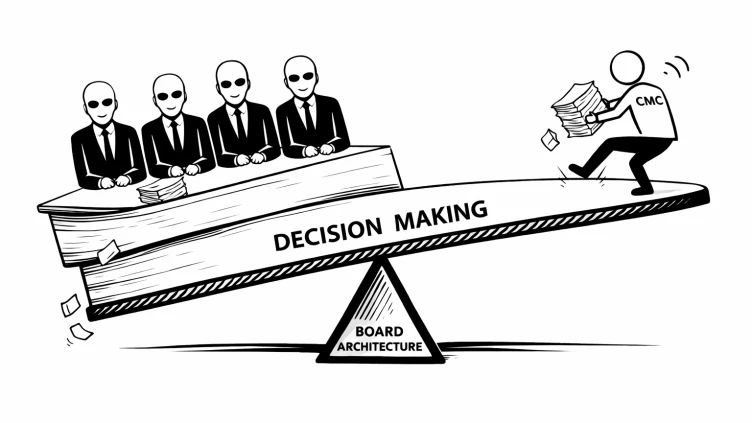
TL;DR: Nobody warns CMC leaders what the boardroom actually feels like when they get there. The "bully" is not always a person — it is a room built on the assumption that your function is a support role, not a value driver. If 50% of the cost base has no expert oversight on the board, that is not a gap. That is a governance problem hiding in plain sight. The following article was written to share observations and lessons of those leaders that have trodden the path before you.
Most CMC leaders spend their entire careers preparing for the boardroom.
Very few are prepared for what actually happens when they get there.
Often, when you come from CMC, the boardroom does not want to hear from you. Not because you are not brilliant. Not because your function does not matter. But because the room was built before you arrived, and the people sitting in it have spent decades making decisions about your function without anyone like you in the chair.
That is not just a gap. That is a culture. Not the one we want to see. But the one that is there.
And if you walk into it without understanding it, it will sweep your feet and leave you wondering what happened.
The Room Was Not Built for You — Yet
I have had this conversation with enough CTOs, SVPs of Technical Operations, and CMC leaders to see the pattern clearly. They get the seat. They bring the insight. And then something happens that nobody warned them about.
The board pushes back. Not with curiosity. With dismissal.
One executive I spoke to recently — someone who has held senior technical leadership roles at multiple public companies — described the dynamic perfectly. They kept making recommendations. Good ones. The kind that, had they been followed, would have changed outcomes. The board did not listen. Not once. Not twice. Repeatedly.
So they left. Went to another company where the CEO promised autonomy. And then the CEO hired someone above them who told the board the exact same things they had been saying. Same ideas, just 'repackaged', and received due to some mysterious level of 'credibility'.
That executive did not stop. They kept showing up. They kept saying the thing that needed to be said. And eventually, they built enough trust that the room was ready to listen — the message didn't change, they changed. They adapted. And they learned how to make the room hear them.
The fact is that you will always have a boss. And sometimes, the boss does not speak CMC. But the best leaders learn how to connect as a human and leverage this to teach the room a new language.
The Bully Is Not Always a Person
Let me be clear about what I mean by "bully."
Sometimes it is a person. A board member who built their career in finance or R&D and has never managed a manufacturing floor. Someone who hears "12-to-15-month sales cycle" and thinks you are selling cupcakes. Someone who looks at your cost base — 50% of total spend — and makes calls about it with the confidence all whilst never having walked into a cleanroom.
But more often, the bully is the room itself. It is the structural assumption that CMC is a support function. That it does not create value. That it only shows up on the KPI dashboard when something goes wrong.
And that assumption is load bearing. It holds up the entire decision architecture of companies that call themselves biotech / pharmaceutical manufacturers but stopped thinking like manufacturers a long time ago.
One of the sharpest minds in technical operations I know put it this way: think about Boeing. A company that literally exists to manufacture things. It lost its way because it got away from manufacturing excellence. That is what landed them in crisis.
Biotech and Pharma has been making the same mistake. Quietly. For decades.
The good news: the people reading this article already know that. And knowing it is the first step to changing it.
The Structural Blind Spot
The CTO position has existed in pockets of biotech & pharma for decades, but for most of the industry it was an afterthought. Manufacturing and Development sat in separate buckets. The head of technical operations was usually just a manufacturing lead — not someone with a seat at the strategic table.
The recognition that these functions need unified, senior-level oversight with real authority only became widespread in the last ten years or so. And even that was driven by crisis — the complexity of cell and gene therapy made it impossible to ignore, and a wave of clinical-stage failures exposed roots in manufacturing that no one on the board had been watching.
So if you look at how boards are made today, here is what you will find. Finance people. Clinicians. R&D scientists. Maybe an academic founder. All perfectly reasonable.
Now ask: is there anyone on that board who has expert oversight of the function that controls 50% of the company's spend?
If you were building a company in any other industry — one where a single function controlled half the cost base — and you did not have someone on the board with deep experience in that function, people would question whether the board was built negligently.
And yet in biopharma, we do this routinely.
That is the bully. Not a person in a chair. A blind spot in the architecture. And the moment you can name it, you can start to change it.
What Happens When Nobody Challenges the Bully
The consequences are not abstract. They show up in the numbers.
Companies that raised $450 million and somehow ran out of cash. Not because the science failed. Because the manufacturing decisions were made by people who did not understand them.
Companies that built internal manufacturing facilities they did not need — spending years and hundreds of millions constructing infrastructure when a leaner approach would have made them more acquirable, not less.
Companies chasing follow-on programs in crowded spaces — 600 CAR-T trials running today, and maybe 3 will make it to the finish line. If you are 7th or 10th to market, you are not going to be safer, you are not going to be more efficacious, and no one is going to acquire you. That is not a pipeline problem. That is a market position problem. And it is the kind of call that requires someone at the board level who understands what it actually takes to manufacture, scale, and compete.
The inability to have those honest conversations — to say this is not going to win, and here is why — is often a governance gap, not a scientific one. It happens when the board does not have the right operational lens to challenge the narrative.
But every one of those examples has a counterpoint. Companies where a strong CMC voice at the board level caught the problem early. Where someone translated the risk before it became a crisis. Where the right perspective in the room saved years and hundreds of millions of dollars.
Those stories do not make headlines. But they are the reason this conversation matters.
The Language Gap
CMC does not speak board. Board does not speak CMC.
If everything is going right, CMC does not show on a KPI dashboard. It does not generate the kind of narrative that excites a VC. It is invisible infrastructure — until something goes wrong, at which point it becomes the only thing anyone talks about.
That is the gap the bully lives in. And until CMC leaders learn to translate their value into the language the room already speaks — capital, risk, return, acquirability — the room will keep making decisions about their function without them.
The good news: this is a skill, not a gift. It can be learned. And the leaders who have learned it are proof that the room can be changed from the inside.
This Is Changing
But here is the thing worth knowing.
This conversation is happening now in a way it was not happening five years ago. The leaders I talk to every week — the ones who have been in these rooms and refused to be quiet — are proof that the room can move. It does not move easily. It does not move fast. But it moves.
More CTOs are being invited to the table. More boards are asking questions about manufacturing risk. More VCs are realizing that the function they used to ignore is the one that determines whether their investment pays off.
You are not walking into a fight you cannot win. You are walking into a fight that is already turning.
It means being ready for the bully. Not because you deserve to be bullied. But because the structural bias is real — and because you are exactly the kind of leader who can dismantle it.
You still have to earn the seat. And then you still have to win the room.
But people are winning it. Every week. One conversation at a time.
In the next piece in this series — CMC 2 Board: From TechOps to the Table — I break down the four moves that the leaders who have won the room actually made. Very few are what you would expect.
Where Phase 3 Search Fits In
The best way to beat a bully is with knowledge. Not just yours. The shared knowledge of people who have been at the table, changed the room, and pioneered the path.
Phase 3 Search exists to make sure that knowledge does not stay locked in private conversations. We are putting it out there. Every week. From the people who have lived it.
Follow along for new content every week from the leaders who have done it.
#CMC2Board #Phase3Search
If this is your discipline, let's talk.
Every engagement begins with a diagnostic — a structured read on the role and the company you are actually inheriting.
Start a diagnostic Our CTO & technical leadership practice →