
Search Engines Killed the Expert. AI Is Killing the Consultant...... Welcome to the Age of the Creative.
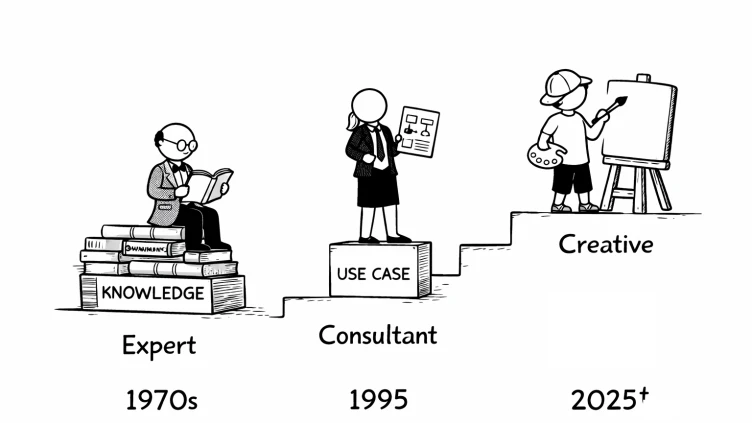
Over the last 40 years, work has moved through three eras. In the first, knowledge lived inside individual heads and the institutions that housed them. In the second, search engines democratized that knowledge and the value shifted to the use case — knowing what to do with what everyone now had access to. Now, generative AI is democratizing the use case itself.
What remains is creativity. Not as a soft skill. As the last structural differentiator standing.
We have entered the age of the creative. And most organizations are not built for it.
The Knowledge Era: When Expertise Lived in One Head
For most of the 20th century, knowledge was institutional property. It lived inside people — specialists, academics, consultants — who spent decades accumulating it. If you wanted to know something, you found someone who knew it. If you wanted to access that knowledge, you joined an institution that housed it.
Think about that for a second.
The value proposition of an expert was not their ability to think. It was their ability to remember. To have read the right papers, attended the right conferences, absorbed the right case studies. Knowledge was scarce, siloed, and slow-moving. And the institutions that collected the most of it — universities, research labs, consulting firms — held enormous structural power as a result.
Then, in December 1995, a search engine called AltaVista launched out of Palo Alto. It received 300,000 hits on its first day. Yahoo had already been indexing the web since 1994. Lycos. Excite. And then, in 1998, a company called Google arrived with a single search bar and one button.
Knowledge was no longer scarce.
It was everywhere.
The Democratization Problem
Here is the thing about democratizing knowledge: it does not just spread what is true. It spreads everything.
Suddenly, the value was no longer in having the information. It was in validating it. Knowing what was accurate. Knowing what applied. Knowing what to do with it.
This is where the use case became king.
If everyone has access to the same knowledge — and by the mid-2000s, they largely did — then the differentiator is no longer what you know. It is what you do with what you know.
And that shift created an entire economic era.
The Use-Case Era: The Rise of the Consulting Class
Look at the numbers. In the early 1980s, the thirty largest consulting firms employed roughly 20,000 people. By 2000, that number was 430,000. Revenue among the top ten global consultancies hit $50 billion. By the 2010s, the management consulting industry was generating somewhere between $100 billion and $300 billion annually, depending on how you define the boundaries.
That is not a coincidence.
Companies did not hire McKinsey, BCG, and Bain because they lacked information. They hired them because they had too much of it and no clear framework for what to do next. The consulting class emerged to answer a single question: given everything we now know, what is the best way to act?
Best practice. Implementation frameworks. Change management playbooks. The use case — the applied layer of knowledge — became the most valuable currency in professional services.
The firms that owned the use case owned the room.
The Use Case Is No Longer Enough
And now, generative AI is doing to the use case what search engines did to knowledge.
It is democratizing it.
Need a go-to-market strategy for a biotech product launch? GenAI will get you 70-80% of the way there. Need a competitive analysis, a regulatory submission framework, a talent mapping exercise? The tools exist. They are getting better every quarter.
The data supports this. Professional services led all sectors in generative AI adoption — implementation rates jumped from 33% in 2023 to 71% in 2024. BCG built "Deckster" to draft initial client presentations from structured datasets in minutes. McKinsey's "Lilli" platform uses generative AI to retrieve, summarize, and contextualize past project learnings.
These firms are not stupid. They see what is happening.
The use case — the thing that justified the billable hour, the six-figure project fee, the army of junior analysts — is becoming a commodity. Clients empowered by AI tools can now generate insights, analyze data, and draft strategies in-house. They are less willing to pay for deliverables they can produce themselves.
If your value proposition is "we know how to do this," you are competing with a tool that also knows how to do this and does not charge by the hour.
The Final Blocker Falls
So where does that leave us?
Knowledge was democratized by search engines. The use case is being democratized by generative AI. What remains?
Creativity.
Not creativity as a soft skill. Not creativity as a nice-to-have. Creativity as the final structural differentiator between organizations that lead and organizations that follow.
Because here is what has actually changed: if you can dream something, you can probably build it. And the barrier to entry is approaching zero.
Want to draw a cartoon? You do not need to know how to draw. Want to design a product? You do not need to be a designer. Want to write code? You do not need to be a developer. The iteration is real — it may take several passes, several prompts, several refinements. But that is not fundamentally different from working with an artist, a designer, or an engineer. The process is the same. The gatekeeping is gone.
This is not hypothetical. Open-source video generation models trained on $200,000 now rival proprietary systems that cost orders of magnitude more to build. AI-assisted creative tools are enabling people with no formal training to produce work that would have required a team and a budget two years ago.
The creative mind is no longer bottlenecked by the creative toolkit.
That changes everything.
But Creativity Without Discipline Is Just Noise
And this is where I think most of the AI conversation gets it wrong.
The question is not "can we build it?" The question is "should we build it?"
Because when the barrier to creation drops to near zero, the volume of what gets created explodes. And most of it will not matter. Most of it will be clever. Some of it will be cool. Very little of it will deliver impact.
There is a useful analogy here, and it comes from my former world, the world of music.
A Moog is one of the most iconic electronic instruments ever built. Invented by Robert Moog in the 1960s, it became the backbone of modern synthesized sound — used by everyone from Stevie Wonder to Kraftwerk to Hans Zimmer. If you have heard an electronic bassline, a sweeping pad, or a sci-fi soundtrack, you have almost certainly heard a Moog.
What makes it relevant here is how it works. A Moog synthesizer does not build sound from silence. It starts with white noise — a signal containing every frequency at equal intensity. Pure chaos. Then it runs that signal through a filter, the famous Moog ladder filter, and carves away everything that does not belong. What remains is the sound you actually want. The genius of a Moog is not in what it generates. It is in what it removes.
The best investment theses work the same way. A strong VC does not start with one idea and hope it scales. They start with a universe of possibilities and filter relentlessly — killing early, killing often, refusing to fall in love with anything that cannot survive scrutiny. The discipline is subtractive. You do not find the best ideas by building more. You find them by removing everything that does not hold up.
That is exactly the skill the age of the creative will demand.
Impact and simplicity. Those are the two filters that will separate signal from noise.
Think about Google's homepage. One search bar. One button. Behind it sits one of the most complex information retrieval systems ever built. But you do not see 99.9% of it. The genius is not in the complexity. It is in the restraint.
Now think about every enterprise software dashboard you have ever used. Four thousand open windows. Seventeen tabs. A help button that leads to a 200-page PDF. We do not need more features. We need more clarity.
I do not buy the narrative that humans are getting dumber. I think we have been conditioned — successfully, over decades — to prefer simplicity. And that conditioning is not a flaw. It is a design requirement.
Which means: the creative output that wins will not be the most sophisticated. It will be the most useful and the most intuitive.
The Trust Problem
There is a clock ticking on all of this.
GenAI is currently in what Gartner calls the "Trough of Disillusionment." Less than 30% of CEOs were satisfied with their returns on AI investments in 2024. A McKinsey analysis found more than 75% of companies lacked a clear AI roadmap. MIT researchers published a study showing 95% of businesses that tried using AI found zero value in it.
Those numbers are uncomfortable.
And they point to a structural risk: if AI keeps making promises it cannot fulfill, people will stop believing it can deliver anything at all. The hype-to-value gap is real, and it is eroding trust.
This is not a technology problem. This is a curation problem. A creative problem. The organizations that figure out how to apply AI to the right problems — problems that deliver measurable, repeatable impact, without hallucination — will define the next era. The ones that deploy it because it is impressive will become case studies in expensive disappointment.
The ability to filter what should be done from what could be done is going to be critically important to the survival of AI in general.
What This Means for How We Hire, Lead, and Connect
I have been thinking about what this means for my own industry — executive search and talent.
AI interviewers, AI screening tools, AI-driven assessments — as data-gathering instruments, they make sense. They can process volume. They can surface patterns. They can reduce time-to-shortlist.
But as tools for human connection? For getting a sense of someone's character, their cultural gravity, their capacity to lead through ambiguity? That does not compute.
Because here is what I think the age of the creative will also demand: a return to the things that make us feel. As more of the functional, transactional, and analytical work gets absorbed by machines, the premium on human judgment, human connection, and human discernment goes up.
Not down. Up.
We are going to have to get better at asking: is what I am seeing real? Is this person who they appear to be? Is this output worth the attention it is demanding?
That is not a technology skill. That is a human one.
A Personal Note
I do not have a neat framework for this. I am watching the same shift everyone else is watching, trying to work out what it means for the leaders I place, the companies I advise, and the firm I run.
What I do believe is this: the organizations that thrive in the age of the creative will not be the ones with the best AI tools. They will be the ones with the sharpest creative judgment — the ability to see what should exist, build it with clarity, and know when to stop.
Knowledge got us to the table. The use case kept us in the room. But creativity is what will determine who leads next.
The blocker is gone. The question is what you build now.
Where Phase 3 Search Comes In
At Phase 3 Search, we have spent years placing leaders who sit at the intersection of technical depth and creative judgment — the people who do not just execute playbooks but design the systems that others follow.
That skill set just became a lot more valuable.
If you are building a leadership team for a world where AI handles the use case and your people need to provide the vision, the creative direction, and the human judgment — that is exactly the conversation we are built to have.
Not because we have a framework for the future. But because we know how to find the people that turn creativity into what every company needs, impact.
If this is your discipline, let's talk.
Every engagement begins with a diagnostic — a structured read on the role and the company you are actually inheriting.
Start a diagnostic How we search →